Direct answer
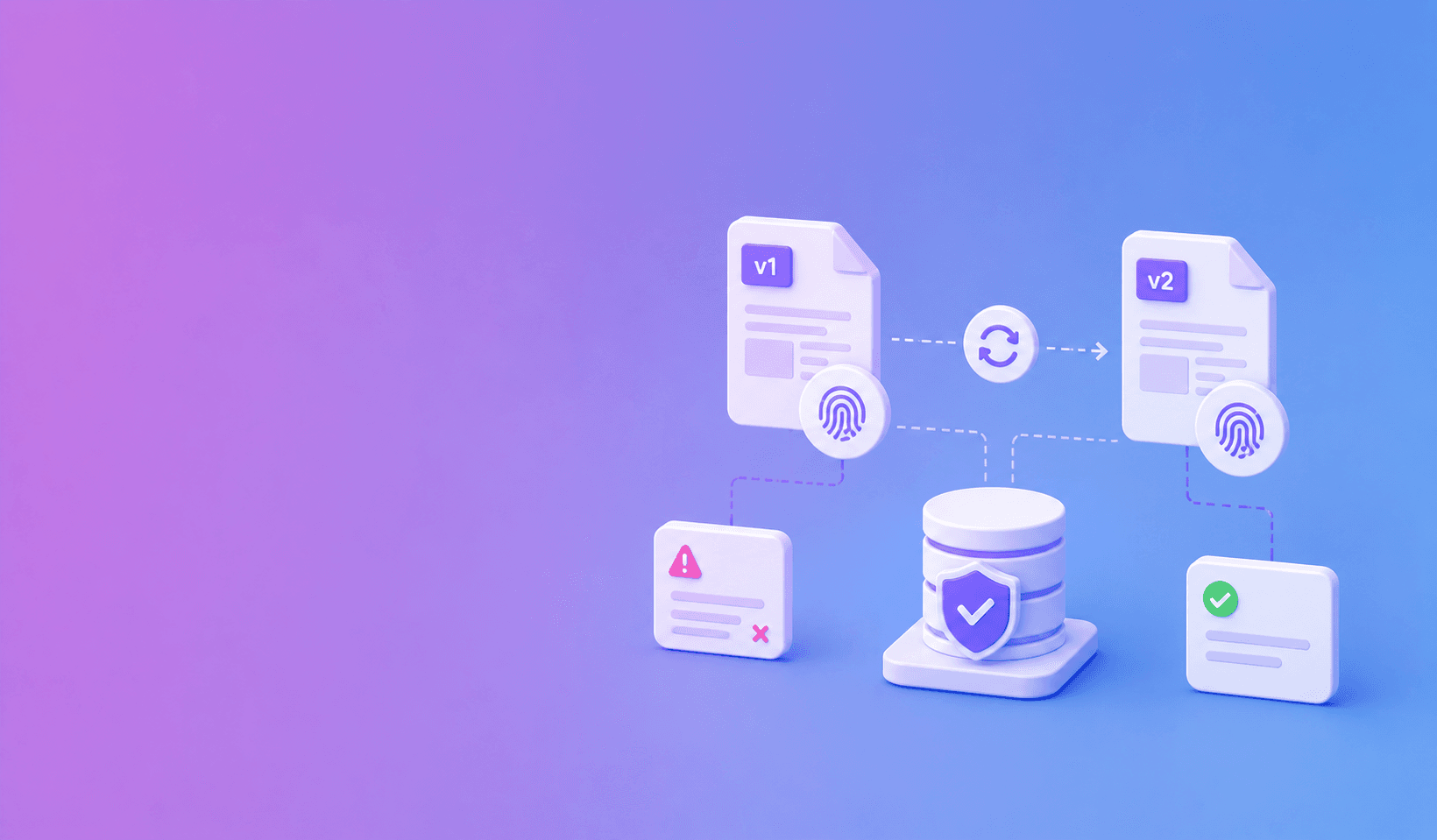
Source fingerprints detect document version drift in RAG by giving document content a machine-testable identity. The system computes a cryptographic digest for the governed source, propagates it to parsed artifacts, chunks, citations, caches, and verification reports, then compares expected and current fingerprints before reuse. A mismatch proves that the artifacts belong to different source content.
This catches silent replacement even when the file name, URL, document title, and relevant sentence remain unchanged. It does not determine which version is approved or effective; source governance owns authority, while fingerprints prove content identity.
NIST’s Secure Hash Standard specifies algorithms that produce message digests used to detect whether messages changed after the digest was generated. In a RAG pipeline, that property becomes a version-drift sensor.
What document version drift means in RAG
Version drift occurs when two pipeline stages believe they are using the same document but actually use different content or derived states.
Examples:
policy.pdfis overwritten while the vector index retains old chunks;- a link opens revision 8, but the answer was generated from revision 7;
- parsed JSON is rebuilt with changed source bytes;
- a source changes after an answer enters cache;
- the parser or normalization profile changes output without an index rebuild;
- one service reads a replicated store before another replica updates;
- a citation refers to old element IDs after front matter is inserted;
- a multi-document source set changes while the query key remains the same.
Drift is dangerous because every local component can look healthy. Retrieval returns text, generation answers fluently, and the citation link opens. Only identity comparison reveals that the components no longer share the same source state.
Why filenames, timestamps, and URLs fail
| Identifier | Why it is insufficient |
|---|---|
| Filename | Can be reused, renamed, or duplicated |
| URL | Can redirect or serve changed bytes |
| Last-modified time | Can be inaccurate, preserved, or changed without content change |
| Database row ID | Identifies a record, not necessarily its content |
| Document title | Many revisions share a title |
| Vector-store namespace | Can contain mixed or partially updated artifacts |
| Semantic similarity | Similar wording does not prove identical content |
A fingerprint answers a narrower question: did the exact input defined by this hash contract change?
Define what the fingerprint represents
“Document hash” is ambiguous unless its input is documented.
| Fingerprint type | Input | Best use |
|---|---|---|
| Source-byte fingerprint | Original file bytes | Detect file replacement |
| Canonical payload fingerprint | Stable parsed-content projection | Detect semantic extraction changes |
| Parser profile hash | Parser configuration and stable assets | Bind output behavior |
| Index-build identity | Source set, chunker, embeddings, and build config | Reproduce retrieval state |
| Source-set fingerprint | Ordered manifest of source IDs and fingerprints | Bind multi-document queries |
Two files can render identically but have different byte fingerprints because of metadata or internal encoding. Conversely, a flawed canonicalization can hide a material difference. Use multiple identities when the use case needs both source custody and stable semantic artifacts.
Ethos distinguishes raw source identity from broader deterministic artifact identity. Its citation freshness checks compare the citation request with the GroundingSource fingerprint available under the active contract; the application must know what that fingerprint represents.
Compute a source-byte fingerprint safely
Stream the file rather than loading a large document into memory.
import hashlib
from pathlib import Path


def sha256_file(path: Path, chunk_size: int = 1024 * 1024) -> str:
    if chunk_size <= 0:
        raise ValueError("chunk_size must be positive")
    digest = hashlib.sha256()
    with path.open("rb") as source:
        while True:
            block = source.read(chunk_size)
            if not block:
                break
            digest.update(block)
    return f"sha256:{digest.hexdigest()}"


fingerprint = sha256_file(Path("policy.pdf"))
assert fingerprint.startswith("sha256:")
assert len(fingerprint) == len("sha256:") + 64
Compute the digest during trusted ingestion. Do not accept a model-returned fingerprint as authoritative, and do not derive source identity from a filename.
NIST has announced plans to revise FIPS 180-4, including removing SHA-1 from the specification. Ethos’s current source-fingerprint contract uses SHA-256, not SHA-1.
Propagate fingerprints through the RAG lineage
The fingerprint should appear in or be referenced by:
source file
  -> ingestion record
  -> parsed document
  -> pages and elements
  -> chunks
  -> embeddings and index rows
  -> retrieval results
  -> generated evidence references
  -> citation verification report
  -> answer release decision
  -> cache and audit record
If a chunk cannot identify its source fingerprint, the release layer cannot prove it came from the currently governed document.
Detect drift at five checkpoints
1. Ingestion
Compare incoming bytes with known revisions. Identical fingerprint can reuse the existing source version; a different fingerprint creates a new content identity.
2. Index build
Assert that every parsed artifact and chunk belongs to the build manifest’s source fingerprints. Reject mixed versions for the same source family unless the index is explicitly historical.
3. Retrieval
Filter by eligible source IDs and fingerprints before vector ranking. Retrieval scores should rank only the approved version set.
4. Answer release
Compare each citation’s fingerprint with the currently selected grounding source. Block or regenerate mismatches even if the quote still exists.
5. Cache reuse
Include source-set or index identity in retrieval and answer cache keys. A question-only key can serve an answer generated from obsolete evidence.
Source-set fingerprints for multi-document RAG
An answer may cite several documents. Build a deterministic manifest:
{
  "contract": "source-set-v1",
  "sources": [
    {
      "source_id": "benefits-policy",
      "fingerprint": "sha256:source-a-digest"
    },
    {
      "source_id": "travel-policy",
      "fingerprint": "sha256:source-b-digest"
    }
  ]
}
Define ordering, encoding, escaping, and field selection before hashing the manifest. Equivalent sets must serialize identically. A source-set hash is meaningless without its canonicalization contract.
Drift detection versus source authority
| Question | Fingerprint answers it? | Correct control |
|---|---|---|
| Are these exact source bytes identical? | Yes, for a source-byte contract | Cryptographic digest |
| Did stable parsed content change? | Only with a canonical payload contract | Canonical artifact fingerprint |
| Is this version approved? | No | Source registry |
| Is it effective for the requested date? | No | Temporal policy |
| Is the user authorized? | No | Access control |
| Does the citation support the claim? | No | Evidence and semantic evaluation |
| Is the source itself correct? | No | Authority, review, and external validation |
Do not turn a matching hash into a green “truth” badge.
How Ethos handles stale fingerprints
Ethos can compare a fingerprint-pinned citation request with the fingerprint exposed by the trusted GroundingSource. When they differ, the verification report marks fingerprint_stale and the submitted request cannot be certified by all_evidence_grounded.
This invalidation is report-level. Otherwise grounded checks are not reusable while the report is stale. That rule matters because a revised document may retain the same quotation; text equality does not repair the submitted request’s version identity.
A correction workflow should:
- preserve the stale report;
- select the intended governed source;
- regenerate or remap citations;
- create a new verification request;
- retain the link between old and new decisions.
The Ethos source-fingerprint guide explains its internal fingerprint layers.
Trigger dependency invalidation on change
When the source fingerprint changes, invalidate or rebuild:
- parsed document output;
- element and table identifiers;
- chunks and embeddings;
- summaries and extracted fields;
- index manifests;
- retrieval and answer caches;
- evidence crops;
- citation verification receipts;
- precomputed semantic evaluations;
- benchmark fixtures that represent current content.
Use a dependency graph, not a fixed time-to-live. An unsafe cached answer remains unsafe until TTL expiration.
Handle parser and configuration drift separately
Source bytes can remain identical while parsed evidence changes because of:
- parser version;
- extraction profile;
- OCR engine or model;
- font and layout behavior;
- normalization rules;
- table reconstruction;
- chunker configuration.
Bind parsed and indexed artifacts to parser, profile, schema, and configuration identities. A source-byte fingerprint alone cannot detect these transformations.
Ethos’s broader canonical document fingerprint is intended to bind more than raw source bytes under its deterministic artifact contract. Do not label an arbitrary parser-output hash as an Ethos document fingerprint unless it follows that contract.
Security and privacy considerations
A hash is not encryption. It does not conceal content, and a digest of a predictable document can be tested for membership if an attacker has candidate files.
Protect:
- fingerprint-to-document mappings;
- tenant-specific source inventories;
- APIs that reveal whether a fingerprint exists;
- audit records connecting users to sources;
- signing or approval records associated with fingerprints.
Use tenant and authorization boundaries even when only a digest is displayed.
Test the drift controls
| Test | Expected result |
|---|---|
| Identical bytes under different filename | Same source-byte fingerprint |
| One-byte source change | Different fingerprint |
| Same filename, replaced bytes | Drift detected |
| New source retains identical quote | Old citation still stale |
| Parser upgrade, same source | Source hash same; artifact/build identity changes |
| Mixed old and new chunks | Index validation fails |
| Cached answer with old source set | Cache reuse fails |
| Foreign parser exposes no fingerprint | Capability limitation remains visible |
| Historical query requests old revision | Old fingerprint allowed under explicit scope |
| Two tenants share identical public file | Access remains tenant-scoped |
Test concurrency too: a source can change between retrieval and release. Recheck freshness at the release boundary.
The definitive verdict
Source fingerprints detect RAG version drift by making content identity comparable across ingestion, parsing, indexing, retrieval, citation, verification, and caching. A mismatch reveals that two artifacts do not belong to the same source version even when names, URLs, and text snippets appear unchanged.
Use SHA-256 source-byte fingerprints for exact file identity, separate canonical artifact and build identities for transformation drift, governed metadata for authority, and Ethos for supported citation-freshness enforcement. Then invalidate every dependent artifact when identity changes. This turns document updates from silent RAG corruption into a visible, testable state transition.
Primary keyword: source fingerprints RAG Optimized meta title: How Source Fingerprints Detect RAG Version Drift Optimized meta description: Learn how source fingerprints detect RAG document drift, invalidate stale citations and caches, and support reproducible verification. Proposed URL slug: how-do-source-fingerprints-detect-document-version-drift-in-rag
Frequently Asked Questions
Free Tool
PDF to JSON
Turn PDFs into structured, source-aware data for RAG, review, and automation.
Try PDF to JSONDocuShell Team
The DocuShell editorial group writes and maintains guides for everyday PDF workflows, with updates made when tool behavior or documented limits change. See our editorial standards for the process behind each article.
Focus: Document fingerprinting, RAG version control, deterministic verification, and cache invalidation
Questions or feedback? Get in touch.