Direct answer
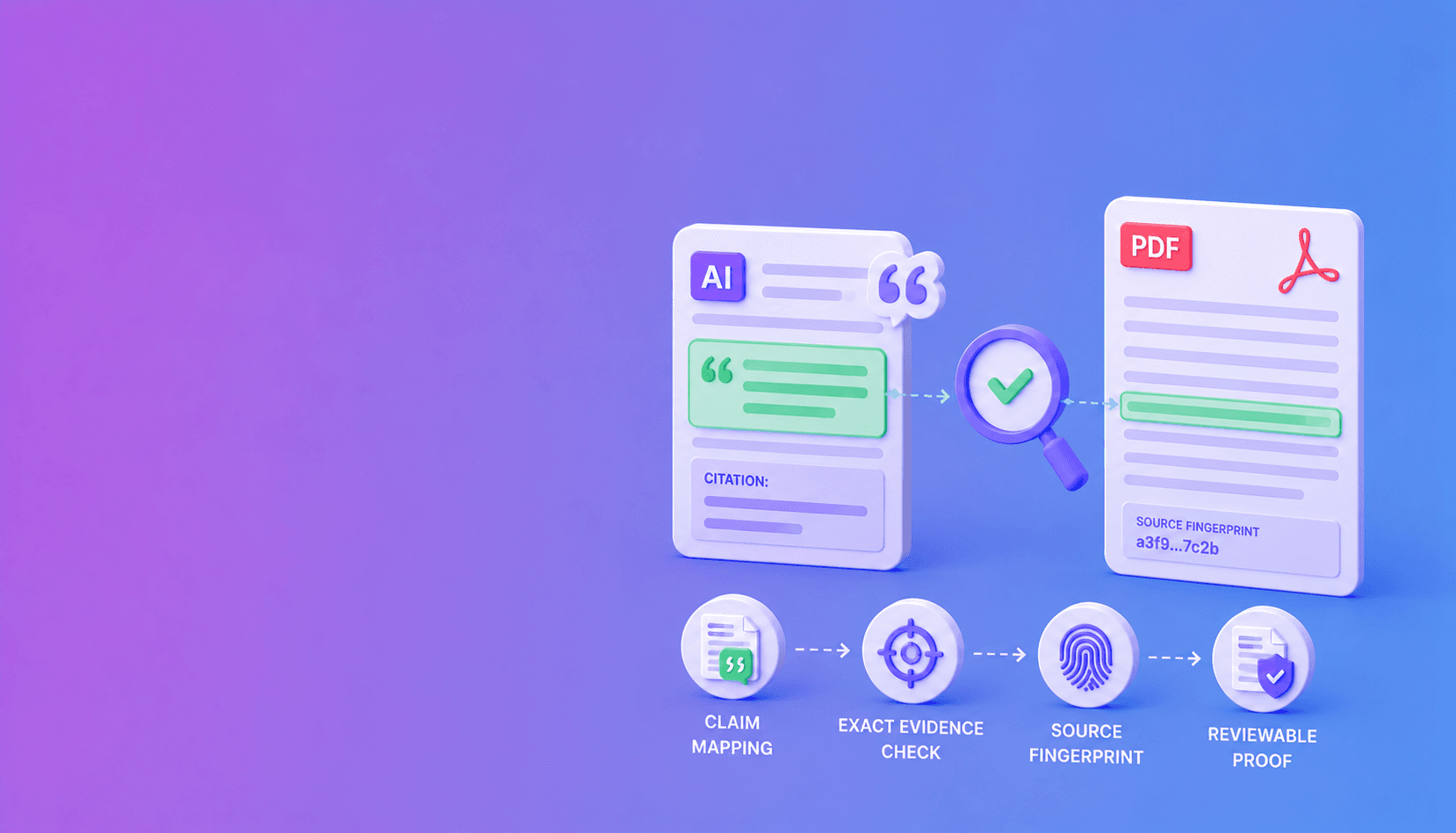
To verify an AI citation, resolve it against a trusted version of the source document, locate the exact evidence it identifies, compare that evidence with the generated claim, and preserve a machine-readable result. A citation marker such as [4], “page 17,” or a document URL proves only that the model emitted a reference. It does not prove that the referenced evidence exists or supports the statement.
A robust workflow separates two questions. Citation grounding asks whether the cited page, quote, value, table cell, or region exists and matches the source. Semantic support asks whether that grounded evidence actually justifies the claim. Ethos is designed for the first question; an application, evaluator, or reviewer must own the second.
If you are building the citation layer itself, begin with the guide to adding page-level citations to PDF RAG answers. If you are deciding how to measure the entire system, use the broader RAG faithfulness and citation-quality framework.
Why citation presence is not citation verification
RAG applications often treat a formatted citation as evidence of quality. That shortcut fails because citation generation is still a model-output task. The model can select the wrong source identifier, copy an outdated page number, attach the nearest retrieved chunk to an unsupported sentence, or cite a passage that contains similar words but not the asserted fact.
There are at least five independent properties to verify:
| Property | Verification question | Typical failure |
|---|---|---|
| Source identity | Is this the intended document? | The citation points to a similarly named file. |
| Source freshness | Is this the version used to generate the answer? | The policy changed after indexing. |
| Locator validity | Does the page, element, or region exist? | A page offset changed during conversion. |
| Evidence integrity | Does the quote, value, or cell match? | The model altered a number or omitted a qualifier. |
| Semantic support | Does the evidence justify the claim? | A true passage is used to support the wrong conclusion. |
The first four can often be checked mechanically. The fifth usually requires explicit application policy, constrained natural-language inference, a calibrated judge, or human review.
Critical distinction: A grounded citation is necessary evidence, not a universal truth certificate. A system should say “the citation was verified against the source,” not “the answer was proven true,” unless relevance and reasoning were evaluated separately.
The evidence model you need before verification
Verification becomes dependable only when the parser preserves source identity. Flattening a 100-page PDF into one unstructured string removes the coordinates needed to answer “where did this claim come from?”
A useful evidence record contains:
- a stable document identifier;
- a fingerprint of the source bytes or canonical source representation;
- the page index and human-facing page label when available;
- element, span, region, or table-cell identifiers;
- extracted text or normalized value;
- bounding-box coordinates and coordinate-system metadata;
- parser identity and declared capabilities;
- warnings when OCR, layout, or table fidelity is limited.
This is why a source-aware PDF parser matters. It preserves the relationship between extracted content and the original page instead of returning text that cannot be traced back.
Source fingerprints prevent silent version drift
A citation can be textually accurate and still be operationally stale. Suppose an employee handbook changes its travel limit from $1,500 to $1,200. An answer generated from the earlier document may still quote a real passage, but it no longer represents the approved policy.
A cryptographic fingerprint binds the citation request to a specific source version. The verifier recomputes or reads the trusted source fingerprint and compares it with the fingerprint attached to the citation set. If they differ, the safe outcome is stale_fingerprint or an equivalent failure—not an optimistic pass based on similar text.
A production verification workflow
The workflow should run after generation but before answer release.
- Require claim-level citations. Each factual claim should list one or more evidence references rather than attaching a bibliography to the answer as a whole.
- Resolve references through a trusted source map. Do not let model-generated document IDs directly choose arbitrary files or network locations.
- Check the source fingerprint. Reject or review citations bound to a different document version.
- Validate every locator. Confirm that pages, elements, regions, spans, and cells exist within valid bounds.
- Compare evidence payloads. Match normalized quotes, values, and table coordinates against the trusted parsed source.
- Record capability limits. A parser without table structure cannot strongly prove a table-cell claim merely because similar text appears nearby.
- Derive a release decision. Show only claims whose grounding, relevance, and synthesis status satisfy product policy.
- Retain an audit artifact. Store the verification report or a privacy-safe receipt long enough to investigate disputes and regressions.
The logic can be represented with a small, fail-closed policy:
type GroundingStatus =
  | "grounded"
  | "mismatch"
  | "not_found"
  | "stale_fingerprint"
  | "capability_limited";

type ClaimDecision = {
  claimId: string;
  grounding: GroundingStatus;
  relevance: "direct_answer" | "supports_answer" | "background" | "unrelated";
  claimType: "source_fact" | "synthesis" | "unsupported";
};

export function mayReleaseClaim(decision: ClaimDecision): boolean {
  const relevant =
    decision.relevance === "direct_answer" ||
    decision.relevance === "supports_answer";

  return (
    decision.grounding === "grounded" &&
    relevant &&
    decision.claimType === "source_fact"
  );
}
The code is intentionally conservative. A grounded synthesis is not necessarily wrong, but it needs a policy that evaluates the reasoning connecting multiple facts. Treating it as a direct source fact would erase an important boundary.
How Ethos handles document evidence
Ethos is a deterministic document evidence layer for source-grounded verification and citation checking. In its current public-beta boundary, it can verify caller-provided citation claims against native Ethos document JSON and supported foreign parser output through a grounding adapter.
The verification path can check evidence such as:
- an exact quotation on a specified page;
- a value associated with a source element;
- page-level presence evidence;
- a table cell when the grounding source exposes table structure;
- a region or element identifier;
- source-fingerprint freshness;
- whether the grounding source lacks a required capability.
Ethos produces structured outcomes rather than a single opaque confidence score. A caller can distinguish a mismatch from missing evidence, stale source identity, invalid input, or a capability-limited check. This distinction is useful in production because the remediation differs: regenerate after source drift, fix the citation after a mismatch, or route to review when the parser cannot expose sufficient evidence.
Ethos does not claim semantic entailment, numerical computation correctness, question relevance, or general factual truth. That explicit boundary makes it suitable as the deterministic layer beneath a semantic evaluator instead of another LLM judge competing for the same role.
Exact matching, normalization, and semantic checks
Exact string equality is useful but insufficient. PDF extraction may normalize ligatures, whitespace, line breaks, Unicode forms, or hyphenation. A safe verifier needs bounded normalization rules that are documented and repeatable.
| Check | Appropriate normalization | Dangerous shortcut |
|---|---|---|
| Quote | Unicode form, whitespace, known line-break hyphenation | Fuzzy matching that accepts materially different wording |
| Numeric value | Locale, separators, explicit units | Dropping signs, currency, percentages, or scale |
| Page presence | Stable page index and source identity | Searching the entire document and ignoring the cited page |
| Table cell | Row, column, header context, normalized value | Finding the number anywhere in extracted text |
| Region | Coordinate system, page size, bounded geometry | Reusing coordinates after a different render or crop |
Semantic evaluation should run after evidence identity is established. Giving a judge only the claim and its verified evidence span reduces distraction from unrelated context. For high-stakes decisions, calibrate that judge against domain-labeled examples and retain a human-review path.
Common implementation failures
Trusting model-returned evidence IDs
A model can fabricate an identifier that looks valid. Evidence IDs should be resolved against a trusted index produced before generation. Unknown IDs must fail as not_found rather than being silently ignored.
Checking the chunk instead of the source
Retrieved chunks are candidates, not canonical proof. Chunk text may be truncated, transformed, deduplicated, or produced from an outdated index. Re-resolve citations against the trusted source artifact before release.
Treating a nearby match as a verified citation
If the cited page is wrong but the same sentence occurs elsewhere, the locator still failed. Quietly repairing it hides a generation error and weakens the audit trail. Report the mismatch; correction can be a separate, visible step.
Ignoring parser capabilities
Plain text cannot prove layout-specific assertions. If a grounding source does not expose tables or coordinates, the report should say so. Capability-aware failure is stronger than a false pass.
How to test the verifier
A useful test corpus contains both valid and adversarial cases:
- correct quote, page, fingerprint, and document;
- correct quote on the wrong page;
- one-character alteration that changes meaning;
- correct number with the wrong unit or sign;
- nonexistent evidence identifier;
- stale source fingerprint;
- table value cited without row or column context;
- a valid citation attached to an unrelated claim;
- an OCR-derived passage with low-confidence extraction;
- a parser source that declares no coordinate or table capability.
Run these cases in CI whenever the parser, citation schema, normalization rules, or release policy changes. The objective is not merely a high pass rate. It is stable, explainable behavior for every failure class.
Definitive verdict
To verify AI citations, build a source-bound evidence path rather than trusting formatted references. Preserve document identity, page and region locators, exact evidence, parser capabilities, and fingerprints. Check those properties deterministically, then evaluate relevance and reasoning as separate axes.
For a practical implementation sequence, use DocuShell Parse PDF to evaluate source-aware document artifacts, add claim-level citations with stable locators, run deterministic evidence checks with Ethos, and apply an explicit release policy. Use the DocuShell hallucination index for broader workflow-risk context, not as a substitute for verifying each citation.
Primary keyword: verify AI citations
Optimized meta title: How to Verify AI Citations Against Sources
Optimized meta description: Verify AI citations against source documents with exact evidence, page, quote, and fingerprint checks. Build an auditable workflow.
Proposed URL slug: how-do-you-verify-an-ai-citation-exists-in-source-document
Frequently Asked Questions
Free Tool
PDF to JSON
Turn PDFs into structured, source-aware data for RAG, review, and automation.
Try PDF to JSONDocuShell Team
The DocuShell editorial group writes and maintains guides for everyday PDF workflows, with updates made when tool behavior or documented limits change. See our editorial standards for the process behind each article.
Focus: Document AI, source-aware PDF processing, RAG evaluation, and citation verification
Questions or feedback? Get in touch.