Direct answer
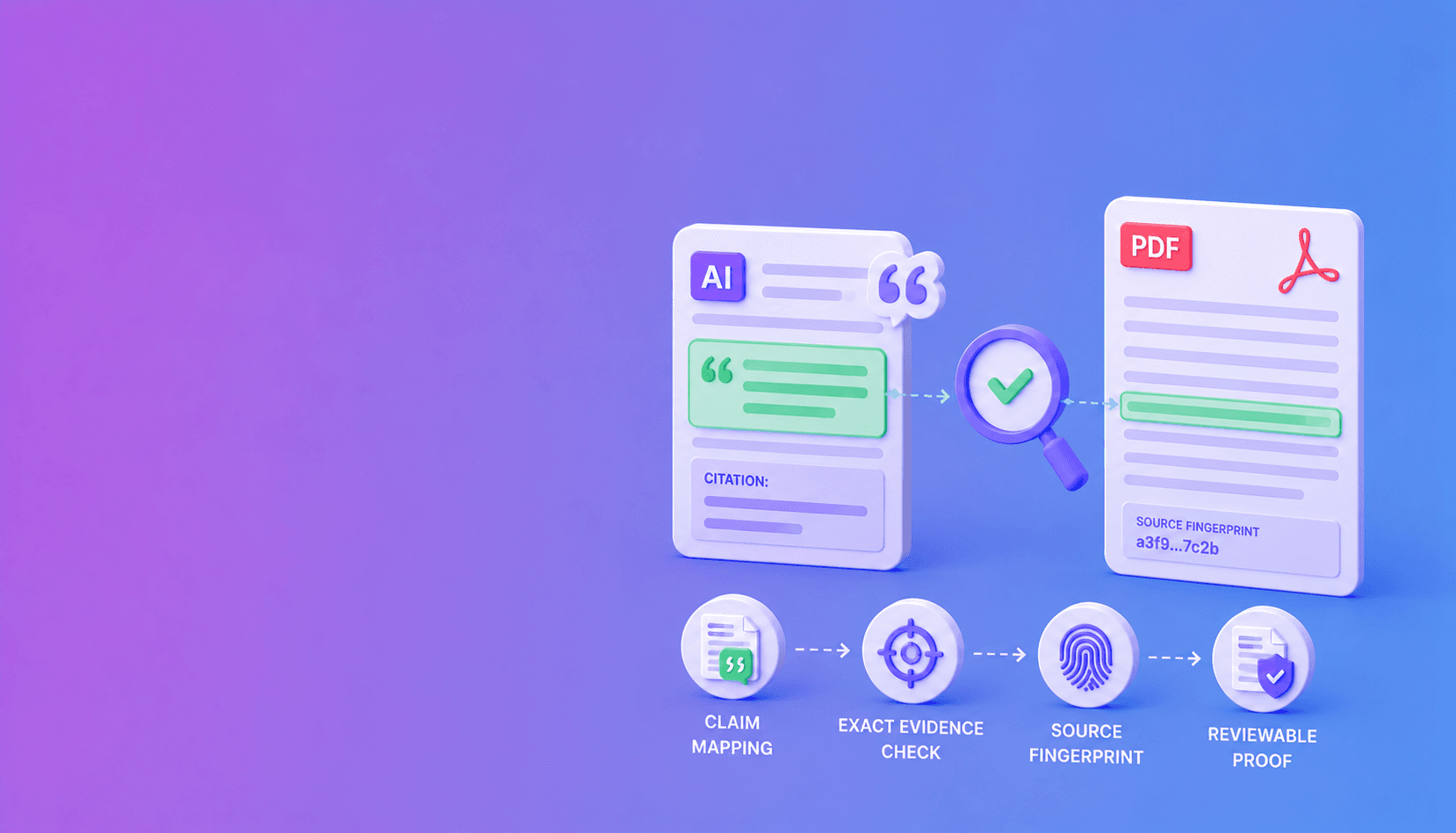
To detect hallucinated citations in RAG, split the answer into factual claims, resolve every citation against a trusted source version, verify its page or evidence locator, compare the expected quote or value, and then evaluate whether that evidence supports the claim. This needs two layers: deterministic evidence verification and semantic claim evaluation.
A source link or citation marker is not enough. A RAG system can fabricate a document identifier, cite the wrong page, quote text that is not present, use an outdated source, or attach real evidence to a conclusion it does not support. Detection must classify these failures rather than hiding them behind one confidence score.
Start with the general AI hallucination prevention guide for system-level controls. Use the AI citation verification workflow when implementing source-bound checks.
What counts as a hallucinated citation?
“Hallucinated citation” describes several different defects. Accurate diagnosis matters because each defect has a different fix.
| Failure class | Example | Correct detection layer |
|---|---|---|
| Fabricated reference | The model emits policy-2025.pdf, but no such source exists | Trusted source-map lookup |
| Invalid locator | The file exists, but page 84 does not | Page or element validation |
| Evidence mismatch | The cited page exists, but the quoted sentence does not | Text or structured-value comparison |
| Stale citation | The quote matched an older document version | Source-fingerprint comparison |
| Misattribution | The evidence occurs in a different source | Document-identity check |
| Semantic overreach | The passage is real, but does not justify the claim | Claim-evidence evaluator or reviewer |
| Citation laundering | A relevant source is attached after generation without evidentiary linkage | Claim-level provenance policy |
| Incomplete coverage | One cited sentence is supported while three other claims are uncited | Claim inventory and coverage check |
These failures cannot be reliably reduced to “the answer has citations.” Citation syntax is a formatting property; citation validity is an evidence property.
Why RAG does not eliminate citation hallucinations
RAG provides context to a model, but it does not force the model to copy that context faithfully. Generation still predicts likely tokens. When several sources look similar, a page number or document name can be selected because it appears plausible in the prompt pattern.
The pipeline also creates opportunities for drift before generation:
- parsing can lose page boundaries or reorder columns;
- chunking can separate a table value from its header;
- indexing can retain an obsolete document version;
- retrieval can return a topically similar but non-authoritative source;
- reranking can optimize semantic similarity rather than evidentiary sufficiency;
- answer generation can introduce uncited model knowledge;
- citation post-processing can attach sources to already-written prose.
The result may look professional while being difficult to audit. The solution is to preserve source identity during ingestion and make citation verification a release requirement.
The two-layer detection model
Layer 1: deterministic citation verification
The deterministic layer tests propositions with clear expected outcomes:
- Does the source identifier resolve?
- Does its fingerprint match the cited version?
- Does the page, element, span, region, or table cell exist?
- Does the expected quotation or value match?
- Does the parser expose the capabilities required for this check?
These checks should produce structured statuses such as grounded, mismatch, not_found, stale_fingerprint, or capability_limited. A status communicates more operational value than a generic score because it tells the system whether to regenerate, re-index, review, or block.
Layer 2: semantic support and answer policy
The semantic layer asks whether grounded evidence actually supports the claim. It must also determine whether the claim directly answers the user, combines multiple facts, performs a calculation, or introduces outside knowledge.
A calibrated LLM judge, NLI model, domain rule, or human reviewer can own this layer. Its input should be restricted to the claim and verified evidence whenever possible. Large amounts of irrelevant context can make a semantic evaluator more likely to rationalize an unsupported claim.
Do not let a semantic judge repair evidence identity. If the citation names the wrong page or stale source, report that defect first. A judge finding similar text elsewhere does not make the submitted citation valid.
A complete detection pipeline
1. Produce a claim inventory
Convert the generated answer into atomic factual claims. One sentence may contain multiple claims:
“Revenue increased 18% to $12.4 million because enterprise demand grew.”
This contains at least three propositions: the percentage change, the ending value, and the causal explanation. Each needs evidence coverage.
2. Require typed evidence references
References should identify their evidence kind. A quote, numeric value, table cell, page-presence assertion, and region require different validation logic. Untyped [3] markers force the verifier to guess.
3. Resolve through an allowlisted source map
The application—not the model—must decide which source IDs correspond to trusted artifacts. Never dereference arbitrary model-generated URLs or file paths during verification.
4. Bind citations to source versions
Attach a cryptographic fingerprint or controlled version identifier. A source update should invalidate old verification receipts unless the evidence is explicitly reverified.
5. Verify locators and evidence
Check page bounds, element IDs, coordinates, normalized quotations, units, signs, table rows, and columns. Preserve the submitted reference in the report so automated correction does not erase the original failure.
6. Evaluate semantic support
For every citation that passes grounding, compare the atomic claim with the verified evidence. Record direct support, partial support, contradiction, or insufficient evidence.
7. Measure coverage
Count all factual claims, not only claims with citations. A system that verifies two citations but ignores five uncited claims should not receive a perfect result.
8. Apply a release policy
Direct source facts with grounded and relevant evidence may be shown. Unsupported claims should be blocked. Multi-source synthesis and calculations should enter a separate review or evaluation path.
Example verification envelope
The final answer gate benefits from an explicit contract:
{
  "answer_id": "answer-7f21",
  "source_set_fingerprint": "sha256:source-set-digest",
  "claims": [
    {
      "claim_id": "claim-1",
      "text": "The 2025 revenue was $12.4 million.",
      "claim_type": "source_fact",
      "citations": ["citation-1"],
      "grounding_status": "grounded",
      "support_status": "direct_support",
      "release_action": "show_final"
    },
    {
      "claim_id": "claim-2",
      "text": "Enterprise demand caused the increase.",
      "claim_type": "synthesis",
      "citations": ["citation-1"],
      "grounding_status": "grounded",
      "support_status": "insufficient_evidence",
      "release_action": "needs_review"
    }
  ]
}
Notice that both claims may point to grounded evidence while receiving different release decisions. The second claim adds causality that the source may not state.
Where Ethos fits
Ethos supplies the deterministic document-evidence layer. It can check caller-provided citations against source evidence exposed by native Ethos document JSON or a supported GroundingSource adapter. Its structured reports distinguish grounded evidence from mismatches, missing targets, stale fingerprints, invalid input, and capability limitations.
This makes Ethos useful beneath RAGAS, DeepEval, TLM-style scoring, or application-specific semantic review. Those tools estimate answer quality or support; Ethos answers the narrower question of whether submitted evidence references bind to the trusted source.
Ethos deliberately does not claim to detect every hallucination. It does not automatically decide whether a grounded passage is relevant, whether a calculation is correct, or whether a synthesis follows logically. Keeping that boundary explicit prevents a deterministic check from being marketed as semantic truth.
RAGAS, LLM judges, and deterministic checks
| Approach | Best use | Main limitation |
|---|---|---|
| Deterministic evidence verifier | Source ID, page, quote, value, cell, region, and fingerprint checks | Cannot judge broad semantic correctness alone |
| RAGAS faithfulness | Claim support against supplied context | Depends on model behavior and context quality |
| DeepEval hallucination metric | LLM-based contradiction or disagreement assessment | Probabilistic and model-dependent |
| Self-evaluation | Low-friction confidence signal | A model may repeat or rationalize its own error |
| Human review | High-stakes ambiguity and domain reasoning | Expensive and difficult to scale |
Use the RAG faithfulness measurement guide to combine these signals without treating any single metric as universal proof.
Adversarial tests every system should run
A credible citation detector must be tested on intentionally deceptive cases:
- A fabricated document ID with realistic naming.
- A valid source and nonexistent page.
- An exact quote assigned to the wrong page.
- A quotation with one inserted or removed negation.
- A correct number with a changed unit, sign, currency, or percentage.
- A table value from the correct row but wrong year column.
- A valid citation from an obsolete source fingerprint.
- A real passage attached to an unrelated claim.
- A multi-claim sentence with evidence for only one claim.
- A synthesis that combines individually grounded facts incorrectly.
- An OCR error that changes a material character.
- A table or coordinate claim over a parser that lacks those capabilities.
Track results per failure class. A single aggregate accuracy score can hide a detector that handles easy quote matches but misses dangerous stale-source or numeric errors.
Operational safeguards
- Fail closed when evidence identifiers or source fingerprints cannot be resolved.
- Treat retrieval chunks and model-selected IDs as candidate evidence, not canonical proof.
- Keep verification reports for incident analysis and regression testing.
- Reverify citations when a source, parser, normalization profile, or schema changes.
- Expose capability limitations to downstream policy and reviewers.
- Show users the page, quote, or crop behind important claims.
- Separate automatic citation correction from verification so failures remain observable.
For document ingestion, DocuShell Parse PDF provides structured output paths that can support source-aware pipelines. The DocuShell hallucination index helps frame broader model and workflow risk, while claim-level citation checks remain the release-control mechanism.
Definitive verdict
Detecting hallucinated citations requires more than an LLM asking whether another LLM seems correct. Use deterministic checks for source identity, freshness, locators, quotations, values, table cells, and capabilities. Then use a calibrated semantic layer for relevance, inference, and reasoning. Finally, require complete claim coverage before releasing the answer.
This layered design does not promise to eliminate hallucinations. It makes failures classifiable, testable, and auditable—which is the requirement production RAG systems actually need.
Primary keyword: detect hallucinated citations in RAG
Optimized meta title: Detect Hallucinated Citations in RAG
Optimized meta description: Detect hallucinated citations in RAG using source fingerprints, exact evidence checks, semantic review, and production release gates.
Proposed URL slug: how-can-you-detect-hallucinated-citations-in-rag
Frequently Asked Questions
Free Tool
Hallucination Index
Compare model factuality signals and estimate workflow hallucination risk.
Try Hallucination IndexDocuShell Team
The DocuShell editorial group writes and maintains guides for everyday PDF workflows, with updates made when tool behavior or documented limits change. See our editorial standards for the process behind each article.
Focus: RAG evaluation, source-aware document processing, AI safety, and citation verification
Questions or feedback? Get in touch.