What one-time delivery actually guarantees
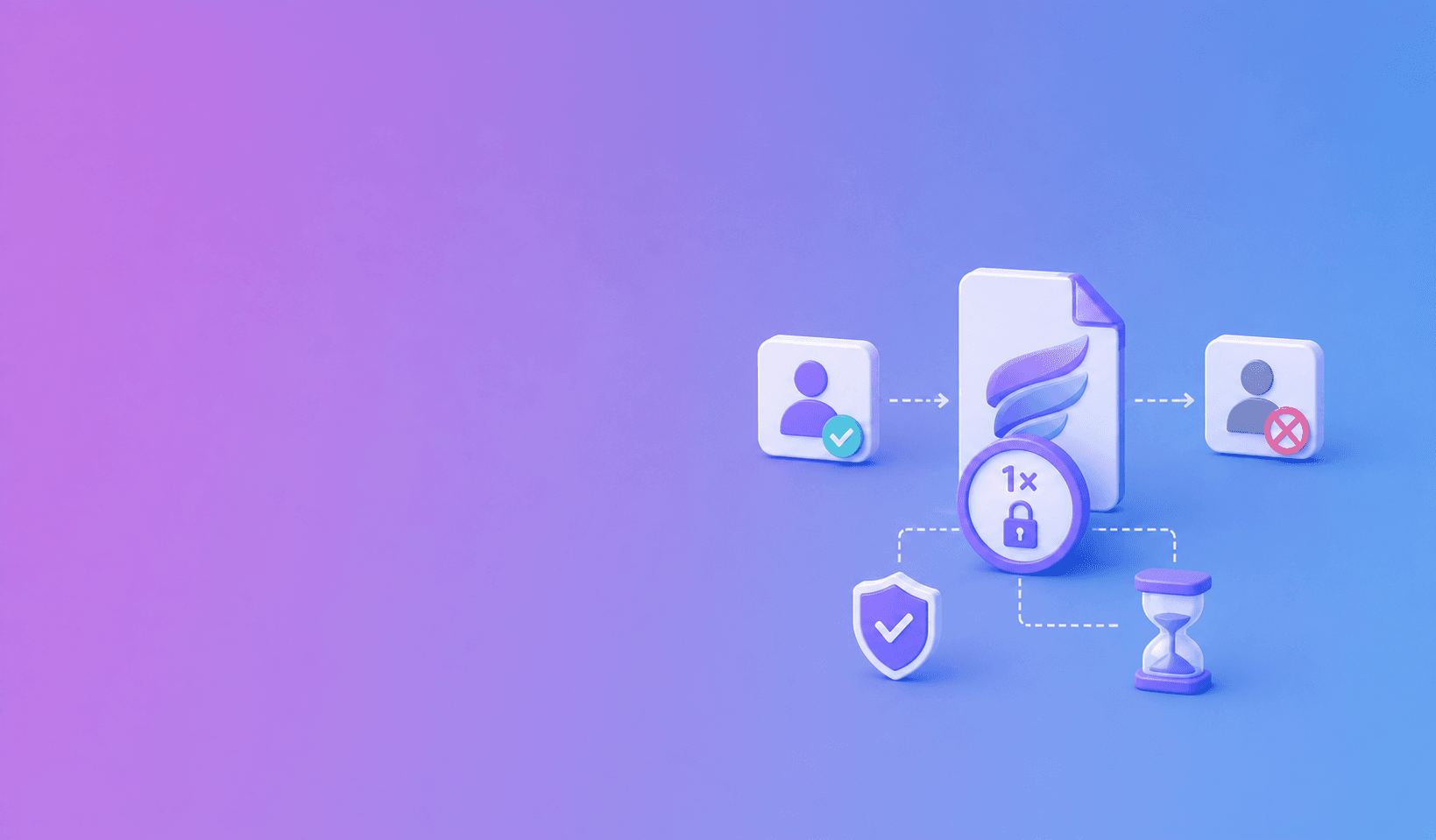
One-time PDF downloads reduce risk by shortening the period during which a generated file exists on the server. The service authenticates the requester, streams the artifact, and deletes it when the transfer completes or stops.
This limits server retention. It does not make the file impossible to copy after delivery.
| Control | Protects against | Does not protect against |
|---|---|---|
| Ownership check | Another account guessing a job ID | Compromised authorized account |
| Single-use claim | Repeated server downloads | Recipient copying the local file |
| Short expiry | Long-lived exposed artifact | Screenshots or forwarded copies |
| Delete on stream close | Orphaned server output | Partial bytes already received |
| Private cache headers | Shared proxy caching | Malware on the recipient device |
Why public file URLs are weak
A permanent or guessable URL can be shared, indexed, logged by intermediaries, or revisited long after the user has finished. Even an unguessable link remains useful to anyone who obtains it until it expires.
Requester-scoped routes add an ownership check before the bytes are sent.
Delete on every stream outcome
Cleanup should run after a successful response and when the client disconnects. The deletion operation must be safe to repeat because several error paths may try it.
DocuShell pairs one-time streaming with a one-hour stale-file sweep. The fallback catches abandoned jobs without turning an hour into the normal retention time.
Protect the route itself
Use authenticated ownership checks, rate limits, non-predictable job IDs, secure transport, and careful response headers. Avoid putting document names or secrets in URLs.
The Security Posture page describes DocuShell's requester-scoped artifact links and cleanup model.
Set the right expectation
If a download is interrupted, the safest response may be to remove the partial server artifact and rerun the operation. Make this clear in the UI.
For workflows that genuinely require repeated downloads or team sharing, build a deliberate storage product with access controls and retention settings. Do not quietly weaken a one-time utility.
Know the boundary
One-time delivery reduces the server's exposure window. Device security, recipient behavior, email forwarding, and downloaded copies remain outside that boundary.
Strong privacy claims explain both what the control protects and what it does not.
The correct streaming lifecycle
Authorize before opening the file. Set response headers, begin streaming, and attach cleanup to completion, close, and error events. Make deletion safe to call more than once.
Do not mark the artifact consumed before the server has committed to delivery, but do not leave it available because a client disconnected midway. The exact retry experience should be documented and tested.
authorized -> claimed atomically -> streaming
                      |              |
                      |              +-> complete -> delete
                      |              +-> disconnect -> delete
                      +-> second claimant -> reject
Concurrency gotcha: a read-then-delete sequence is not enough. Two requests can pass the read check before either deletes the file. Claim the artifact atomically before streaming.
Race conditions to test
Try two simultaneous download requests, a browser refresh, a slow client, a connection drop, a worker restart during streaming, and a cleanup sweep racing with download. Confirm unauthorized requests cannot consume or extend the artifact.
Use an atomic claim or lock so two requests do not both pass the one-time check.
Cache and proxy behavior
Sensitive one-time responses should use suitable private cache controls. Review CDN and reverse-proxy configuration so an authenticated artifact is not cached and replayed outside the application.
Sanitize the download filename and keep secrets out of the URL. Log identifiers and outcomes, not file contents.
When one-time delivery is the wrong model
Team review, repeated downloads, and long-running audit access need a managed storage workflow with explicit permissions and retention. Do not stretch a one-time endpoint into a document repository.
Continue with secure PDF download links, short file-retention design, and safe handling of confidential PDFs. The DocuShell Security Posture describes the implemented delivery boundary.
Frequently Asked Questions
DocuShell Team
The DocuShell editorial group writes and maintains guides for everyday PDF workflows, with updates made when tool behavior or documented limits change. See our editorial standards for the process behind each article.
Focus: Secure artifact delivery and ephemeral PDF processing
Questions or feedback? Get in touch.