Direct answer
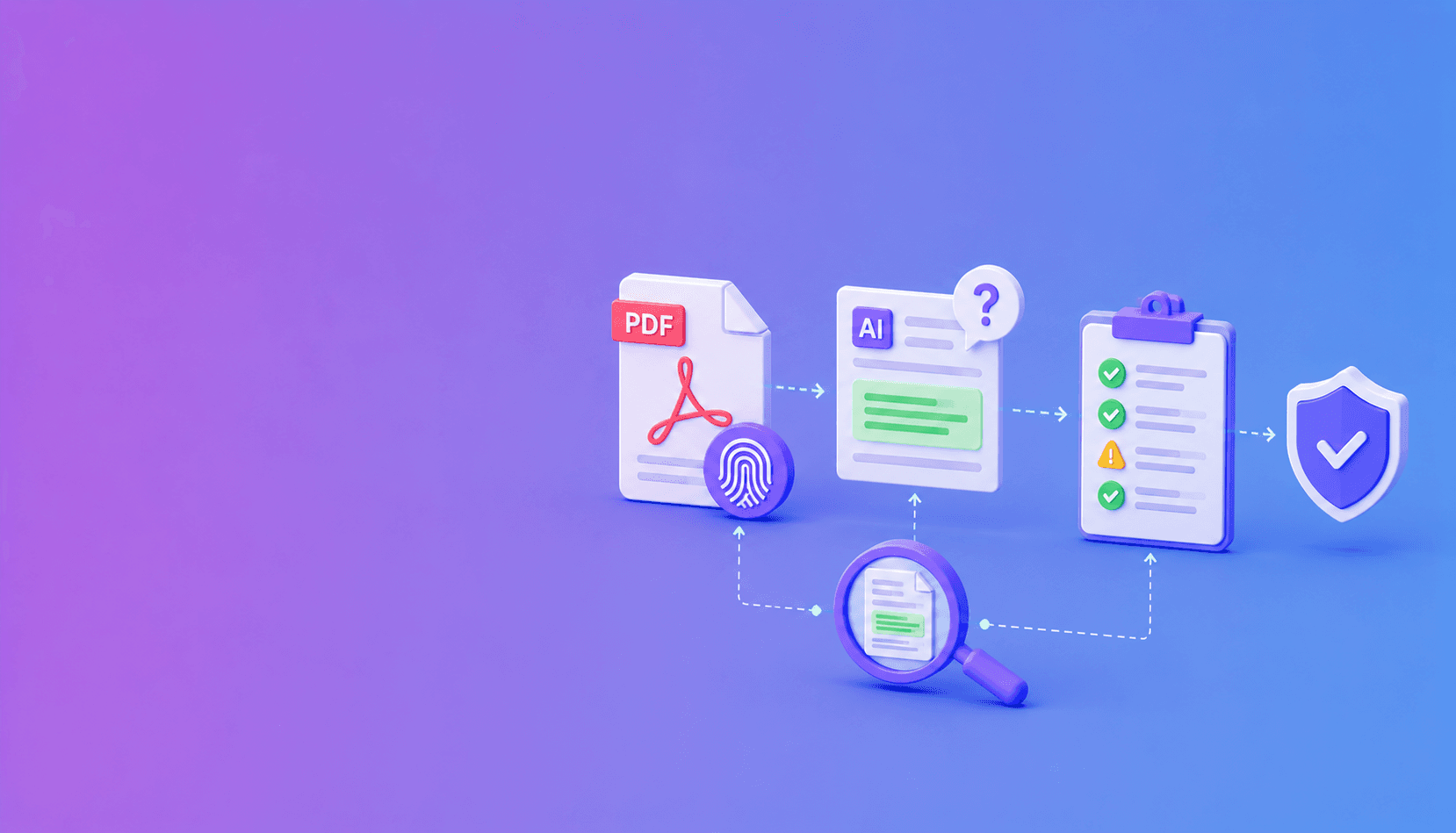
An auditable RAG pipeline preserves a reconstructable chain from each released answer claim back to a governed source version. It records source eligibility, parser and index versions, retrieved evidence, claim-level citations, deterministic verification results, semantic-review outcomes, and the policy that decided whether to show, review, or block the answer.
Auditability is not the same as logging every prompt. A useful audit record explains what evidence was available, what was asserted, what was verified, what remained uncertain, and why the application took its final action. It should do this without unnecessarily retaining confidential document content.
Begin with source-aware PDF parsing, then use the original-PDF answer verification workflow to connect generated claims back to evidence.
Define the audit question before choosing tools
“We store traces” is not an audit strategy. Define which questions an investigator must answer:
- Which user, service, or workflow requested the answer?
- Which source documents were eligible under access policy?
- Which exact source versions were parsed and indexed?
- What evidence did retrieval return?
- Which model and prompt policy generated the response?
- Which factual claims did the application identify?
- Which citations resolved to canonical evidence?
- Which claims were direct source facts versus synthesis?
- Which checks failed, warned, or were capability-limited?
- Why was a claim shown, sent to review, or blocked?
These questions determine the event schema. Starting from a vendor dashboard often produces abundant telemetry but insufficient evidence for a dispute.
The nine layers of an auditable RAG pipeline
| Layer | Required control | Evidence to retain |
|---|---|---|
| Source governance | Authority, version, access, retention | Source ID, fingerprint, status, effective date |
| Ingestion | Safe acquisition and validation | MIME checks, security findings, ingestion event |
| Parsing | Source-aware structured extraction | Parser/profile version, page and element identity, warnings |
| Indexing | Provenance-preserving transformation | Index version, chunk-to-source mapping, embedding configuration |
| Retrieval | Reproducible evidence selection | Query, filters, retrieved IDs, scores, reranking version |
| Generation | Controlled model execution | Model snapshot, prompt-policy version, output schema |
| Verification | Claim and citation checks | Canonical verification report and limitations |
| Release | Explicit answer policy | Claim labels, decision, reason, reviewer if applicable |
| Monitoring | Regression and incident response | Aggregated metrics, sampled failures, revalidation events |
Every layer can invalidate later evidence. A perfectly logged model response is not auditable if its chunk IDs cannot be mapped back to a known source version.
Layer 1: govern the source universe
Enterprise RAG should not index “whatever files are available.” Create a controlled source catalog with:
- canonical source ID;
- cryptographic content fingerprint;
- owner and approving authority;
- effective and expiration dates;
- draft, approved, superseded, or archived status;
- tenant and access-control scope;
- retention and deletion policy;
- source-system revision identifier.
At query time, authorization must filter sources before retrieval. Post-retrieval masking is too late because unauthorized content may already influence generation.
Compliance boundary: Evidence auditability does not justify indefinite content retention. Preserve minimal identifiers and decision records where possible, apply retention schedules, and keep sensitive text or crops only when policy permits.
Layer 2: validate document ingestion
Treat uploaded documents as untrusted input. Validate actual file signatures, enforce size and page limits, isolate parsing workers, detect encrypted or malformed files, and record security warnings. For PDFs, account for hidden text, attachments, scripts, overlapping content, and image-only pages.
An ingestion record should bind the received bytes to the canonical fingerprint before transformations occur. If preprocessing changes the document, record both input and derived-artifact identity.
Layer 3: parse without losing provenance
The parser should preserve page boundaries, spans, regions, tables where supported, coordinate conventions, and capability limits. Every element used for retrieval needs a path back to the source.
Useful provenance fields include:
{
  "source_id": "employee-policy",
  "source_fingerprint": "sha256:source-digest",
  "parser_id": "approved-parser-profile",
  "parser_version": "pinned-version",
  "page_index": 18,
  "element_id": "p18-e09",
  "parent_id": "section-travel",
  "capabilities": ["text", "coordinates"],
  "warnings": []
}
Do not claim table-cell or region verification if the parser exposes only flattened text. Capability declarations are part of the audit evidence.
Layer 4: make indexing reproducible
Chunks are derived evidence, not canonical sources. Record:
- chunker version and configuration;
- parent element and page IDs;
- source fingerprint;
- transformations and normalization profile;
- embedding provider and model snapshot;
- index build identifier;
- creation time and source-catalog snapshot.
When a source changes, mark dependent chunks and prior citations stale. Silent partial index updates make incident reconstruction difficult.
The PDF chunking guide that preserves citations provides practical chunk design.
Layer 5: record retrieval as evidence selection
Capture more than the final top-k text. Record candidate IDs, filters, ranking stages, reranker version, selected evidence IDs, and scores. Where privacy policy permits, preserve a bounded snapshot or hashes of selected context.
Separate three questions:
- Did retrieval find the needed evidence?
- Did it exclude ineligible or superseded sources?
- Did generation use the evidence correctly?
Combining them into one end-to-end score prevents effective diagnosis.
Layer 6: control generation
Pin or identify the model snapshot, system policy, prompt template, structured-output schema, tool configuration, and decoding parameters. Store secrets and full sensitive prompts separately from general telemetry.
Require structured claim output when possible:
{
  "answer": "Employees must submit approved travel expenses within 30 days.",
  "claims": [
    {
      "id": "claim-1",
      "text": "Employees must submit approved travel expenses within 30 days.",
      "claim_type": "source_fact",
      "evidence_refs": ["policy:p18-e09"]
    }
  ]
}
Treat model-returned evidence IDs as untrusted. Resolve them through an application-controlled source map before verification.
Layer 7: verify claims and citations
Run deterministic checks for source identity, fingerprint freshness, locator validity, quote or value matching, table-cell context, and source capabilities. Then run semantic checks for relevance and claim support.
Ethos provides the deterministic citation-grounding component. It asks whether caller-provided citations bind to evidence exposed by a trusted GroundingSource. The canonical verification report should remain available even when the UI displays a derived verified, partially_verified, or unverified summary.
Keep the three axes separate:
| Axis | Owner | Decision question |
|---|---|---|
| Citation grounding | Ethos or deterministic verifier | Does the evidence reference exist and match? |
| Question relevance | Application or evaluator | Does the evidence help answer this question? |
| Synthesis level | Application policy | Is the claim directly stated or inferred? |
Use the RAG faithfulness, groundedness, and citation-verification comparison to select complementary evaluators.
Layer 8: make release decisions explicit
An application should not translate one successful citation into “answer verified.” Evaluate every material claim.
A conservative policy is:
- show grounded, relevant source facts;
- show only the verified subset when an answer is partial, with disclosure;
- route supported synthesis to review unless explicitly approved;
- recompute calculations with deterministic code;
- block irrelevant, unsupported, stale, or mismatched claims;
- state that the sources cannot answer when relevant grounded facts are unavailable.
Record a stable decision reason, policy version, and referenced verification-check IDs. If a human overrides the decision, capture the reviewer identity, justification, and time.
Layer 9: monitor and revalidate
Auditability decays if source and software changes are ignored. Trigger revalidation when:
- a source fingerprint changes;
- an approved source is superseded;
- the parser or normalization profile changes;
- chunking or embedding configuration changes;
- the citation schema changes;
- the release policy changes;
- a semantic judge model or prompt changes.
Monitor rates by failure class: missing evidence, mismatches, stale fingerprints, capability limitations, unsupported synthesis, abstentions, and reviewer overrides. Aggregate rates are more useful when they preserve the underlying categories.
A practical audit-event schema
The event should be immutable or append-only after release and should reference canonical artifacts rather than duplicate them unnecessarily.
type AuditEvent = {
  eventId: string;
  occurredAt: string;
  tenantId: string;
  requestId: string;
  policyVersion: string;
  modelSnapshot: string;
  indexVersion: string;
  eligibleSourceFingerprints: string[];
  retrievedEvidenceIds: string[];
  verificationReportRef: string;
  releasedClaimIds: string[];
  reviewClaimIds: string[];
  blockedClaimIds: string[];
  decision: "show_final" | "show_partial" | "needs_review" | "block";
  reasonCodes: string[];
};

export function validateAuditEvent(event: AuditEvent): void {
  if (!event.eventId || !event.requestId || !event.verificationReportRef) {
    throw new Error("Audit event is missing required identity fields");
  }
  if (event.decision === "show_final" && event.blockedClaimIds.length > 0) {
    throw new Error("A final answer cannot include blocked claims");
  }
}
In production, protect event integrity, restrict access, document retention, and avoid storing raw prompts when stable references or redacted envelopes are sufficient.
Auditability versus observability
| Property | Observability | Auditability |
|---|---|---|
| Primary user | Operator or engineer | Reviewer, auditor, risk owner, investigator |
| Time horizon | Live and recent diagnosis | Later reconstruction and accountability |
| Typical data | Latency, traces, errors, token use | Source versions, evidence, checks, decisions |
| Success criterion | Explain system performance | Explain and substantiate released output |
| Retention | Operationally optimized | Policy and legal requirements |
The same trace system can support both, but the data contract and governance requirements differ.
Threat model and failure cases
Test the pipeline against:
- a user who lacks access to one retrieved source;
- a draft document with higher semantic similarity than the approved version;
- a source replaced without changing its file name;
- a model that fabricates realistic evidence IDs;
- a parser that loses a material table header;
- a valid citation attached to an irrelevant claim;
- a grounded synthesis containing faulty causality;
- a reviewer override without justification;
- deletion requests affecting retained evidence;
- an index rebuild that changes chunk IDs;
- a judge-model update that changes historical scores.
Each case should have an expected control, audit event, and remediation path.
Definitive verdict
An auditable enterprise RAG system is an evidence and decision system, not merely a chatbot with traces. Govern source eligibility, preserve provenance through parsing and indexing, record retrieval, require claim-level citations, verify evidence deterministically, evaluate relevance and synthesis separately, and retain a privacy-aware release record.
Use DocuShell Parse PDF for source-aware document artifacts, Ethos for deterministic citation grounding, and the DocuShell hallucination index for broader workflow-risk context. The final application policy—not the model alone—must decide what users can see.
Primary keyword: auditable RAG pipeline
Optimized meta title: How to Build an Auditable RAG Pipeline
Optimized meta description: Build an auditable RAG pipeline with governed sources, verified citations, release gates, and privacy-aware evidence records.
Proposed URL slug: how-do-you-build-an-auditable-rag-pipeline-for-enterprise-documents
Frequently Asked Questions
Free Tool
PDF to JSON
Turn PDFs into structured, source-aware data for RAG, review, and automation.
Try PDF to JSONDocuShell Team
The DocuShell editorial group writes and maintains guides for everyday PDF workflows, with updates made when tool behavior or documented limits change. See our editorial standards for the process behind each article.
Focus: Enterprise document AI, RAG architecture, evidence provenance, and verification controls
Questions or feedback? Get in touch.