Direct answer
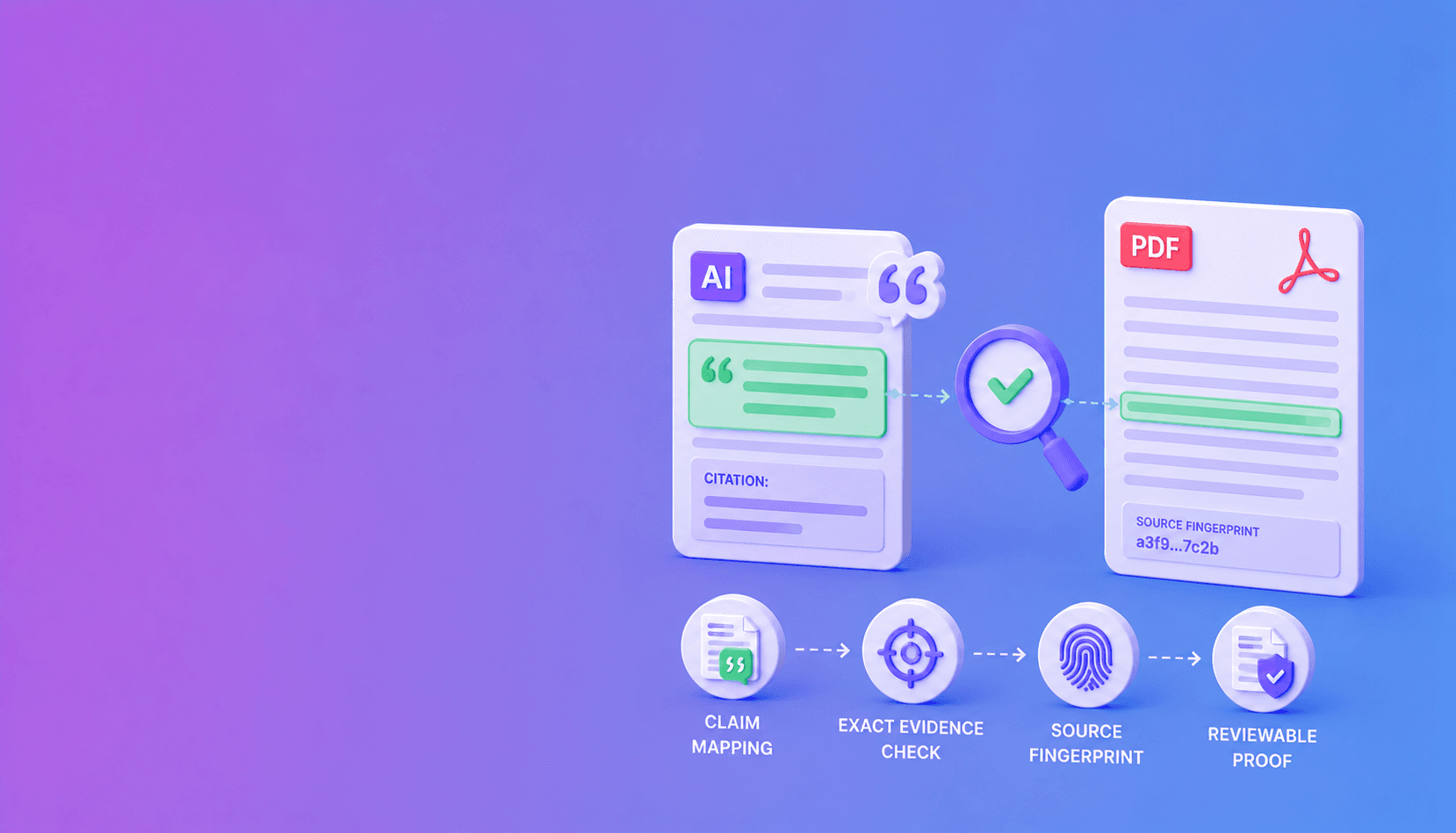
Claim-level citation verification in RAG means decomposing an answer into atomic material claims, assigning each claim one or more precise evidence references, and checking each relationship independently. The workflow verifies source identity, fingerprint freshness, locator validity, quote or value integrity, citation coverage, and semantic support without treating the whole answer as one unit.
This solves a common citation illusion. A paragraph may contain four claims and one footnote. The source might support the first claim but not the other three. Paragraph-level formatting makes the entire paragraph look sourced; claim-level verification exposes the actual coverage.
Research on citation-generating language models supports this separation. The ALCE benchmark paper evaluates fluency, correctness, and citation quality as distinct dimensions, while RAGTruth documents unsupported and contradictory content in RAG-generated responses. A production system therefore needs finer evidence units than “answer has citations.”
What counts as an atomic claim?
An atomic claim is the smallest material proposition that can be evaluated as supported, unsupported, contradicted, calculated, or outside scope without changing another proposition.
Consider:
Q3 revenue was $12.4 million, up 18.1% year over year, because enterprise demand accelerated.
This sentence contains at least three claims:
- Q3 revenue was $12.4 million.
- Revenue increased 18.1% year over year.
- Enterprise demand caused the increase.
They require different proof:
| Claim | Type | Evidence requirement |
|---|---|---|
| Revenue amount | Direct source fact | Financial table cell with period, unit, and scale |
| Growth percentage | Calculation | Two verified values plus deterministic formula |
| Causal explanation | Synthesis or analysis | Supporting commentary and semantic review |
One revenue-table citation does not prove causation.
Claim-level citation verification has four separate questions
1. Citation coverage
Does every material claim that needs evidence have at least one citation?
2. Evidence integrity
Does the submitted source, fingerprint, page, element, quote, value, table cell, or region exist and match?
3. Semantic support
Does the verified evidence actually support the claim rather than merely discuss the same topic?
4. Answer completeness
Did retrieval and generation omit required facts, exceptions, or counterevidence needed to answer the question safely?
These properties can disagree. A citation can exist and match while being irrelevant. Every claim can have a citation while the answer omits a material exception. A semantically supported claim can cite the wrong page.
Citation correctness versus citation completeness
The terms are easy to confuse.
| Metric | Question | Example failure |
|---|---|---|
| Citation presence | Did the output contain a citation marker? | [3] exists but resolves nowhere |
| Citation correctness | Does cited evidence support the attached claim? | Source discusses revenue but not the claimed amount |
| Citation completeness | Are all material source-dependent claims cited? | Two of five factual claims have no citation |
| Citation grounding | Does the reference bind to exact source evidence? | Correct quote is assigned to the wrong page |
| Answer completeness | Does the answer cover necessary aspects? | Governing exception is omitted entirely |
A basic coverage metric can be expressed as:
weighted citation coverage =
  sum(materiality weight of cited claims)
  / sum(materiality weight of all citation-required claims)
Do not use equal weights automatically. An uncited introductory phrase and an uncited dosage, policy exception, or financial limit have different risk.
The claim-to-evidence graph
Claim-level verification is not always one claim to one citation.
claim A ----> evidence 1
claim B ----> evidence 2 ----> evidence 3
claim C ----> verified input 4 + verified input 5 + calculation
claim D ----> no evidence -> block or abstain
Common relationships include:
- one-to-one: one direct fact maps to one passage;
- one-to-many: a synthesis requires several passages;
- many-to-one: one table or policy clause supports several narrow claims;
- calculated: a result depends on verified inputs plus code;
- conflicting: sources disagree and require explicit resolution;
- uncited: no acceptable evidence exists.
Represent those relationships directly instead of inferring them from citation placement in rendered prose.
A claim-level answer schema
{
  "answer_id": "answer-0194",
  "answer": "Q3 revenue was $12.4 million, an 18.1% increase year over year.",
  "claims": [
    {
      "id": "claim-revenue",
      "text": "Q3 revenue was $12.4 million.",
      "claim_type": "source_fact",
      "materiality": "high",
      "citation_required": true,
      "evidence_refs": ["ev-revenue-q3"]
    },
    {
      "id": "claim-growth",
      "text": "Revenue increased 18.1% year over year.",
      "claim_type": "calculation",
      "materiality": "high",
      "citation_required": true,
      "evidence_refs": ["ev-revenue-q3", "ev-revenue-prior-q3"],
      "calculation_ref": "calc-percentage-change-v2"
    }
  ],
  "evidence": [
    {
      "id": "ev-revenue-q3",
      "source_id": "q3-report-2025",
      "document_fingerprint": "sha256:source-digest",
      "page_index": 17,
      "table_id": "income-table",
      "row": "Revenue",
      "column": "Q3 2025",
      "expected_value": "12400000",
      "unit": "USD"
    }
  ]
}
The schema distinguishes the rendered answer, claim graph, evidence objects, and computation. Stable IDs let verification reports and user interfaces reference the same proposition.
Step 1: extract claims without changing the answer
Claim extraction can happen during generation or as a separate pass. Generating structured claims alongside the answer reduces alignment work, but model output must still be validated.
Apply these rules:
- preserve the exact released wording;
- split conjunctions when propositions can fail independently;
- separate direct facts from inference and recommendation;
- separate values from calculations;
- preserve negation, modality, dates, units, and scope;
- do not invent implicit claims absent from the answer;
- assign stable, unique IDs;
- record the extraction model or rule version.
For high-risk workflows, sample claim decomposition for human review. An extractor that merges claims can hide partial support; one that fragments every phrase creates noisy verification.
Step 2: decide which claims require citations
Not every phrase needs a source, but every material source-dependent proposition does.
Citation-required examples:
- document facts and quotations;
- dates, amounts, limits, percentages, and thresholds;
- policy or contract requirements;
- clinical or legal assertions;
- claims about a named entity or event;
- calculations based on source values;
- synthesis attributed to documents.
Potentially non-citation-required content includes clearly marked transitions, user-provided facts, and transparent calculations whose verified inputs are cited. Record the reason when a material claim is exempt.
Step 3: resolve evidence through a trusted map
Model-generated source IDs are untrusted. Resolve them against the sources authorized and eligible for the request. Confirm:
- source authority and version;
- source fingerprint;
- access policy;
- page and element existence;
- evidence capability;
- exact quote, value, cell, or region.
Retrieved chunks are not automatically canonical evidence. Re-resolve references against the governed source artifact before release.
Step 4: run deterministic grounding checks
Ethos verifies caller-provided citation claims against a trusted GroundingSource. It can distinguish grounded, mismatched, not-found, stale, unsupported, invalid, and capability-limited outcomes according to the active source and verification contract.
Use deterministic checks for:
- fingerprint equality;
- page, element, span, table, cell, and region existence;
- quote or value matching;
- coordinate and page bounds;
- required source capabilities.
The AI citation source-verification guide explains those checks in detail.
Step 5: evaluate semantic support claim by claim
Give the evaluator one atomic claim and only its verified evidence plus necessary context. Classify:
- direct support;
- partial support;
- contradiction;
- insufficient evidence;
- evaluator uncertainty.
Do not ask a semantic judge to repair missing or stale citations. The deterministic layer establishes the evidence object first. Calibrate the semantic evaluator against expert labels, especially for qualifiers, exceptions, causal claims, and domain-specific language.
Step 6: recompute calculations
For a calculated claim:
- verify every source input;
- confirm units, periods, signs, and scope;
- call a versioned deterministic function;
- record rounding and tolerance;
- link the calculation run to the claim;
- block if any input becomes stale.
An LLM judge should not decide whether arithmetic “looks right.”
Step 7: make release decisions at claim level
from dataclasses import dataclass
from typing import Literal


@dataclass(frozen=True)
class ClaimResult:
    claim_id: str
    materiality: Literal["low", "medium", "high"]
    grounding: Literal["grounded", "failed", "limited"]
    semantic_support: Literal["direct", "partial", "none", "uncertain"]
    calculation_valid: bool


def release_action(result: ClaimResult) -> str:
    if result.grounding == "failed" or not result.calculation_valid:
        return "block"
    if result.grounding == "limited":
        return "review"
    if result.semantic_support == "direct":
        return "show"
    if result.semantic_support in {"partial", "uncertain"}:
        return "review"
    return "block"
For Python versions before 3.8, Literal is available from typing_extensions. The policy should also verify that removing blocked claims does not make the remaining answer misleading.
Measure claim-level performance
Track more than an answer-level pass rate:
- weighted citation coverage;
- grounded citation rate;
- semantically supported claim rate;
- unsupported high-materiality claim rate;
- stale citation rate;
- capability-limited rate;
- calculation failure rate;
- partial-answer release rate;
- reviewer override rate;
- false-pass and false-block rates against labeled cases.
Report by claim type and domain. A system can score well overall while failing frequently on calculations or policy exceptions.
Test adversarial claim mappings
| Test | Expected behavior |
|---|---|
| One sentence contains three claims, one citation | Two uncovered claims are identified |
| Correct passage attached to unrelated claim | Grounding passes; semantic support fails |
| Two claims share one valid table cell | Both mappings remain explicit |
| Synthesis needs two sources but cites one | Partial support routes to review |
| Citation fingerprint is stale | All dependent claim proof is invalidated |
| Correct values produce wrong percentage | Calculation claim blocks |
| Model fabricates evidence ID | Not-found result blocks |
| Source lacks tables | Table-cell claim is capability-limited |
Include omission cases where a material exception never appears in the answer. Citation verification alone cannot score a claim that was never generated; answer-completeness testing must cover it.
User-interface design
Render citations next to the smallest readable claim span, but keep the internal claim graph independent from typography. Show:
- source title and exact version;
- page, section, or table-cell context;
- exact evidence;
- claim-level status;
- calculation status where applicable;
- partial or review disclosure;
- authorized link to the original evidence.
Avoid decorating an entire paragraph green because one claim passed. The audit-ready answer guide provides a complete answer envelope.
The definitive verdict
Claim-level citation verification is the bridge between “the answer contains sources” and “each material proposition has inspectable support.” It separates citation coverage, evidence grounding, semantic support, calculations, and answer completeness so failures can be diagnosed and governed independently.
Use Ethos for supported deterministic evidence checks, a calibrated evaluator or reviewer for semantic support, code for calculations, and application policy for materiality and release. The result is not a guarantee of universal truth. It is a precise record of which claims were supported, which evidence was verified, and which parts of the answer must be qualified, reviewed, or blocked.
Primary keyword: claim-level citation verification Optimized meta title: What Is Claim-Level Citation Verification? Optimized meta description: Learn how claim-level citation verification maps RAG claims to exact evidence, checks coverage and grounding, and enables safer answer release. Proposed URL slug: what-is-claim-level-citation-verification-in-rag
Frequently Asked Questions
Free Tool
Hallucination Index
Compare model factuality signals and estimate workflow hallucination risk.
Try Hallucination IndexDocuShell Team
The DocuShell editorial group writes and maintains guides for everyday PDF workflows, with updates made when tool behavior or documented limits change. See our editorial standards for the process behind each article.
Focus: RAG evaluation, atomic claim extraction, citation grounding, and evidence-based release controls
Questions or feedback? Get in touch.