Direct answer
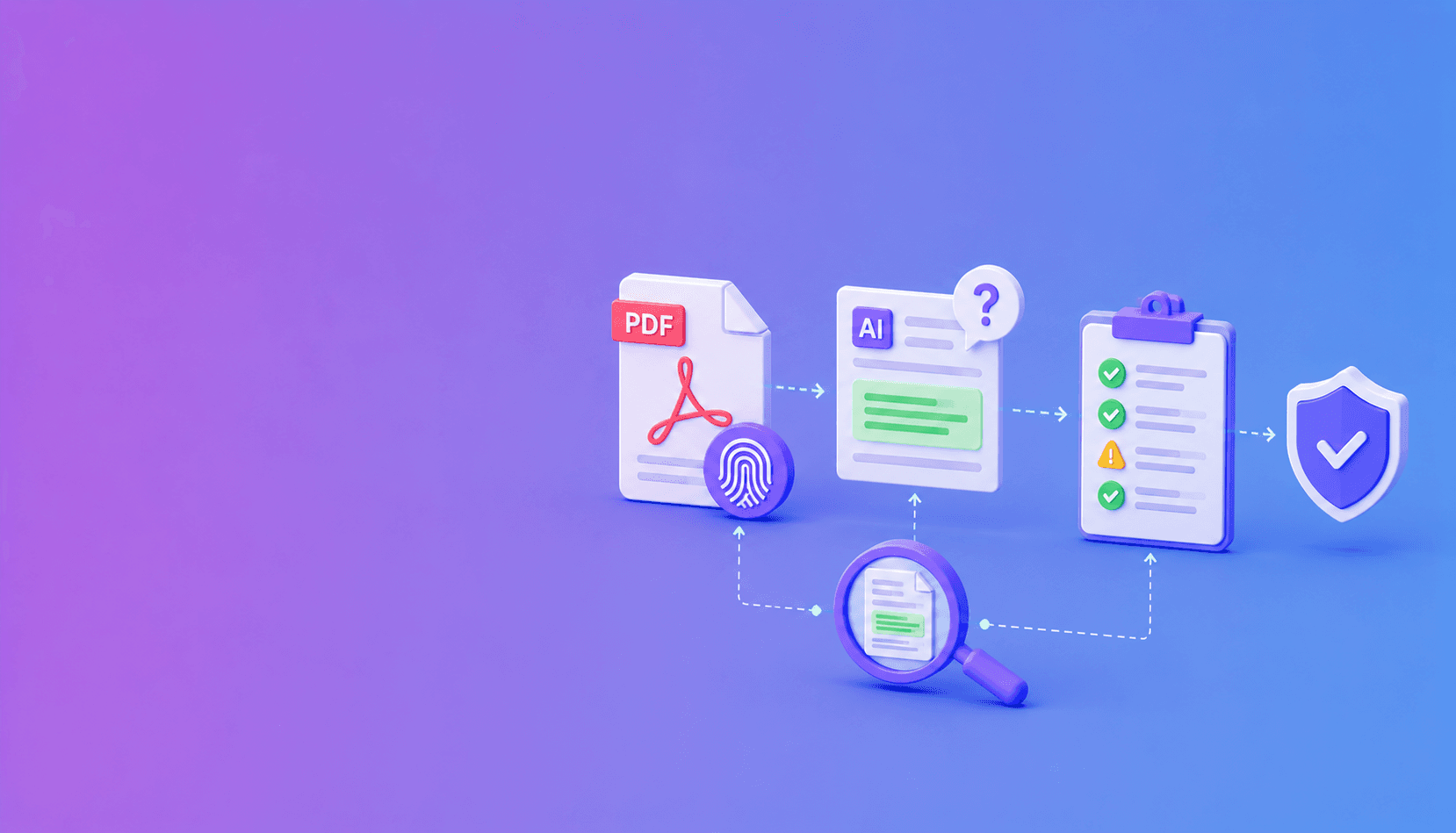
Ethos is a deterministic document evidence layer for source-grounded verification and citation checking. It tests whether caller-provided AI citations bind to identifiable evidence—such as pages, text elements, quotations, values, table cells, regions, and document fingerprints—in a trusted grounding source.
Ethos is not a general semantic truth engine. It does not claim that a grounded passage answers the user’s question, that a calculation is correct, or that a multi-source conclusion is logically valid. It supplies the auditable evidence layer beneath those application decisions.
The citation grounding guide explains the underlying problem. The deterministic RAG verification-gate guide shows how an application can use Ethos before answer release.
The problem Ethos is designed to solve
Most document AI pipelines move through four stages:
document
  -> parser and structured artifacts
  -> retrieval and generated answer
  -> displayed citations
The final citation may look authoritative without proving that the cited page, quote, number, or region exists in the intended source version. Retrieval chunks are candidates, not proof. Model-returned evidence IDs are untrusted output.
Ethos adds a verification step:
AI citation claims + trusted document evidence
                  -> Ethos verification
                  -> structured report + optional proof summary
This lets a pipeline distinguish evidence that is grounded from evidence that is mismatched, missing, stale, unsupported, or limited by source capabilities.
What “deterministic evidence layer” means
Deterministic verification asks bounded questions with reproducible answers:
- Does this evidence ID exist?
- Does this page or element locator resolve?
- Does the expected quote match the source text?
- Does the requested value match a structured element or table cell?
- Does the citation fingerprint match the source fingerprint?
- Does the source expose enough structure to verify this evidence kind?
Given the same verifier version, configuration, citation request, and grounding source, these checks are intended to produce the same classifications. This is different from asking an LLM judge for a probability that an answer is hallucinated.
What Ethos can produce
For supported born-digital PDF and native JSON workflows, Ethos can produce or participate in:
- structured document JSON;
- Markdown and plain-text projections;
- retrieval-ready chunks and citation references;
- page and text coordinates;
- citation verification reports;
- evidence-anchor reports;
- crop descriptor JSON;
- optional rendered source crops when PDFium is configured;
- source fingerprints;
- capability warnings and security signals.
Not every output is available with every grounding source. A foreign parser adapter can expose only what its original format contains.
The three architectural areas
| Area | Responsibility | Why it matters |
|---|---|---|
| Document layer | Parsing, structure, canonical document graph | Preserves source identity and inspectable elements |
| RAG artifact layer | Chunks and citation references | Carries provenance into retrieval workflows |
| Verification layer | Evidence, fingerprints, grounding, reports | Tests whether submitted references bind to source evidence |
The verification layer is intentionally parser-neutral. Ethos’s own parser is one possible grounding source rather than a privileged truth hidden inside the verifier.
GroundingSource: the parser-neutral boundary
A parser integrates by implementing or adapting to GroundingSource. The contract exposes:
- parser identity and adapter identity;
- declared capabilities;
- document fingerprint when available;
- pages and geometry;
- elements and text;
- spans where supported;
- tables and cells where supported;
- stable IDs and coordinate conventions.
The integration shape is:
your parser output
  -> GroundingSource adapter
  -> caller-provided citation claims
  -> ethos-verify
  -> VerificationReport
This design lets a team keep its existing extraction system while adding a common citation-verification boundary. The current repository documents native Ethos JSON and an OpenDataLoader-style JSON adapter path.
Evidence checks and outcomes
| Evidence concern | Example | Useful outcome |
|---|---|---|
| Exact evidence | Quoted text differs from the source | Mismatch |
| Locator | Element or page cannot be resolved | Not found |
| Freshness | Citation belongs to another source fingerprint | Stale |
| Capability | Parser does not expose table cells | Capability limited |
| Input validity | Citation schema or locator is malformed | Invalid request or usage error |
| Successful binding | Source, locator, and evidence match | Grounded |
The structured distinction matters operationally. A stale citation requires re-indexing or regeneration. A malformed request requires an integration fix. A capability limit may require a higher-fidelity parser or human review.
Canonical reports and proof summaries
The canonical verification report is the audit artifact. It preserves individual checks, warnings, capability limitations, and overall grounding state.
Applications may derive a simpler proof summary:
- verified: the submitted verification request is fully certified by its grounding checks;
- partially verified: some grounded checks can be reused, but the request as submitted is not fully certified;
- unverified: no check is reusable for proof.
The summary should not erase the report. A user interface may display a concise status while retaining the underlying evidence for review.
What Ethos deliberately does not claim
Ethos is not:
- a general factual-truth oracle;
- an automatic semantic-entailment judge;
- a guarantee that an answer is relevant;
- a calculator for derived values;
- a hosted API in the current repository boundary;
- a general office-document conversion platform;
- a base OCR engine for image-only PDFs;
- a benchmark-proven parser-quality leader;
- a replacement for source governance or access control.
The base parser currently targets a narrow born-digital PDF path. Image-only or scanned pages require OCR outside that base path and should surface an ocr_required condition rather than pretending text was extracted.
Native parsing and foreign parser verification
Ethos can be used in two broad modes.
Native Ethos evidence
The native path parses supported born-digital PDFs into source-aware artifacts containing pages, elements, coordinates, chunks, citations, and fingerprints. This provides the fullest current evidence shape.
Bring your own parser
A foreign parser remains responsible for extraction. An adapter maps its output into Ethos concepts. If the source lacks spans, tables, fingerprints, or crop support, the adapter declares that limitation.
This is safer than silently inferring unavailable evidence. A plain-text source may support quote checks but cannot strongly prove a table-cell or page-region claim.
How an application uses Ethos safely
- Govern the set of trusted source documents.
- Parse documents into source-aware artifacts.
- Preserve fingerprints and evidence IDs through chunking.
- Ask the generator for structured claims and citations.
- Resolve model-returned references through a trusted source map.
- Run Ethos citation verification.
- Keep the canonical verification report.
- Label claim relevance and source-fact versus synthesis status.
- Recompute calculations with deterministic code.
- Release, partially release, review, or block according to application policy.
The original-PDF verification workflow expands these steps.
Example application policy
| Ethos grounding | Relevance | Claim type | Default application action |
|---|---|---|---|
| Verified | Direct answer | Source fact | Show final |
| Verified | Supports answer | Source fact | Show with appropriate context |
| Verified | Direct answer | Synthesis | Review or semantic policy |
| Verified | Background only | Any | Block from main answer |
| Partial | Direct answer | Source facts | Show only certified subset with disclosure |
| Unverified or stale | Any | Any | Block or regenerate |
A green citation result should never automatically release unrelated prose.
Local execution and security posture
Ethos is designed around local/offline base execution rather than requiring a network judge. That can help teams keep private document evidence within controlled infrastructure.
PDFs remain hostile input. Hosted or service deployments need subprocess or sandbox isolation, CPU and memory limits, timeouts, output limits, file-descriptor limits, and network restrictions. PDFium-backed behavior uses an explicit caller-provided PDFium library path in the current public-beta boundary.
Local execution does not remove the need for access control, logging policy, patch management, or source governance.
How Ethos differs from common RAG evaluators
| Tool category | Primary question | Relationship to Ethos |
|---|---|---|
| RAG faithfulness metric | Does context semantically support the answer? | Complementary semantic layer |
| LLM-as-a-judge | Is the answer relevant, correct-looking, or supported? | Complementary probabilistic evaluation |
| Observability platform | What happened across the request trace? | Can store Ethos reports and decisions |
| Document parser | What content and structure can be extracted? | Can feed Ethos through an adapter |
| Ethos | Do citations bind to source evidence? | Deterministic evidence layer |
The LLM-as-a-judge reliability guide explains why exact checks and semantic judgment should remain separate.
Who should evaluate Ethos
Ethos is most relevant when a team needs:
- claim-level source traceability;
- local or controlled evidence processing;
- deterministic citation regression tests;
- stale-source detection;
- inspectable page, region, or crop evidence;
- parser-neutral verification contracts;
- explicit limitation reporting rather than optimistic scores.
It is less suitable as a standalone answer-quality evaluator when the primary problem is open-ended reasoning, conversational quality, or broad factual correctness without source-bound citations.
Definitive verdict
Ethos is a deterministic document evidence and citation-verification layer. Its role is to establish whether submitted references bind to trusted, versioned source evidence and to report exactly what was grounded, stale, missing, mismatched, or beyond source capabilities.
Use DocuShell Parse PDF to evaluate source-aware document preparation, Ethos for citation grounding, and the DocuShell hallucination index for broader model and workflow risk. Add semantic evaluation and application release policy above Ethos rather than stretching its evidence contract into a universal truth claim.
Primary keyword: what is Ethos document AI
Optimized meta title: What Is Ethos for Document AI?
Optimized meta description: Learn how Ethos deterministically verifies AI citations against source-bound pages, text, values, regions, tables, and fingerprints.
Proposed URL slug: what-is-ethos-deterministic-evidence-layer-for-document-ai
Frequently Asked Questions
Free Tool
PDF to JSON
Turn PDFs into structured, source-aware data for RAG, review, and automation.
Try PDF to JSONDocuShell Team
The DocuShell editorial group writes and maintains guides for everyday PDF workflows, with updates made when tool behavior or documented limits change. See our editorial standards for the process behind each article.
Focus: Document AI, deterministic evidence systems, source-aware parsing, and citation verification
Questions or feedback? Get in touch.