Direct answer
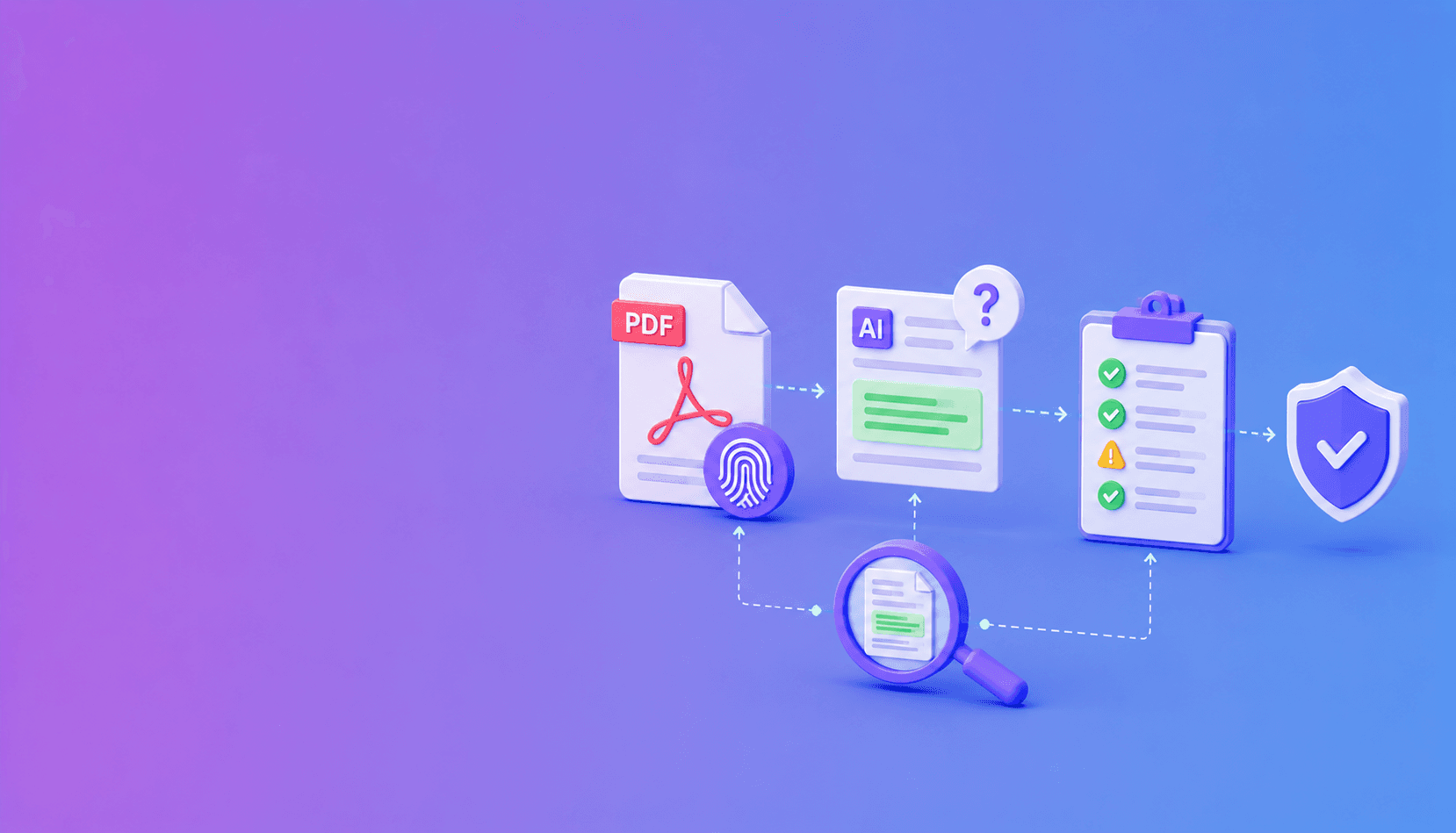
Insurance AI verifies answers against policy documents by first assembling the complete governing policy packet, then binding every material answer claim to versioned clause-level evidence. The verifier confirms source fingerprints, pages, sections, quotations, values, and supported table fields. A separate coverage workflow evaluates whether those provisions apply to the loss facts, dates, jurisdiction, insured, property, limits, exclusions, conditions, and endorsements.
The complete-packet step is essential. A base policy form can be changed by declarations, schedules, riders, amendments, and endorsements. An answer grounded in real base-form language can still be wrong if a later endorsement replaces that clause.
This article describes evidence engineering, not legal advice or an automated coverage determination. The NAIC’s adopted Model Bulletin on the Use of Artificial Intelligence Systems by Insurers provides governance and risk-management expectations for insurer AI use and discusses validation, testing, documentation, consumer outcomes, and third parties. It is a model bulletin rather than a universal law; insurers must assess the requirements applicable in each jurisdiction.
The policy packet is the unit of truth
Insurance RAG should not retrieve from a folder of unrelated forms. It should operate over a policy packet assembled for a specific policy, insured, and relevant date.
| Packet component | Typical role |
|---|---|
| Declarations | Named insured, policy period, locations, coverages, limits, deductibles |
| Base form | Core insuring agreements, definitions, exclusions, conditions |
| Endorsements | Add, remove, or replace base-form terms |
| Schedules | List covered property, vehicles, locations, persons, or classifications |
| Riders or amendments | Modify coverage for specific products or circumstances |
| Notices | May explain rights or changes but may not itself be operative contract text |
The application must know which components are operative and their precedence. Do not let semantic similarity decide whether an endorsement modifies a base clause.
Why policy-document answers fail
Insurance documents create predictable RAG traps:
- a model cites a base exclusion that an endorsement removed;
- the wrong policy period is retrieved;
- a limit from one location is applied to another;
- a deductible is confused with a coverage limit;
- “you” or “insured” is interpreted without the definitions section;
- an exception to an exclusion is omitted;
- a schedule entry is detached from its column headers;
- a form from another state is retrieved;
- renewal documents are mixed with the prior term;
- OCR changes a policy number, dollar amount, or negation;
- a claims manual is presented as contract language;
- a quotation exists, but the loss facts do not satisfy its conditions.
These are not all model hallucinations. Many are source assembly, document precedence, versioning, retrieval, or application-policy failures.
Build the governing policy packet manifest
Create a manifest before indexing or answering:
{
  "packet_id": "packet-policy-84729-term-2026",
  "policy_number_token": "policy-token-84729",
  "jurisdiction": "CA",
  "effective_from": "2026-01-01",
  "effective_until": "2027-01-01",
  "documents": [
    {
      "source_id": "declarations-2026",
      "role": "declarations",
      "fingerprint": "sha256:declarations-digest",
      "precedence": 100
    },
    {
      "source_id": "base-form-ho-00-03",
      "role": "base_form",
      "fingerprint": "sha256:base-form-digest",
      "precedence": 10
    },
    {
      "source_id": "endorsement-water-backup",
      "role": "endorsement",
      "fingerprint": "sha256:endorsement-digest",
      "precedence": 90
    }
  ]
}
The precise precedence model depends on the product, contract, and jurisdiction. Encode only rules approved by policy and legal specialists. The manifest’s purpose is to prevent generation from silently mixing documents outside the governing packet.
Step 1: capture the question and loss context
Normalize the context needed to choose policy evidence:
- policy packet and term;
- named insured or claimant scope;
- date and location of loss;
- coverage and property type;
- reported cause and event sequence;
- relevant limits and deductibles;
- endorsements and scheduled items;
- jurisdiction;
- user role and authorization;
- question purpose: explanation, triage, adjudication support, or communication.
Do not infer critical context from prose if a controlled field is available. A question about “water damage” may require distinguishing flood, sewer backup, accidental discharge, seepage, and ensuing loss.
Step 2: parse and index with policy provenance
Every retrievable element should retain:
- packet ID and source ID;
- source fingerprint and document role;
- form number, edition, and endorsement identity;
- page, section, element, and parent IDs;
- effective period and jurisdiction;
- definitions referenced by the clause;
- modification or replacement relationships;
- page geometry, tables, and extraction warnings;
- parser, chunker, and index versions.
Index definitions and exceptions with bidirectional links. A chunk containing an exclusion should reference its exceptions and relevant definitions even if they appear elsewhere.
Do not claim table-cell verification when only flattened text is available. Schedules and declarations frequently require row-and-column evidence.
Step 3: split the answer into claim types
An answer may contain different propositions:
The policy includes $10,000 of water-backup coverage, subject to a $1,000 deductible, but gradual seepage is excluded.
Split it into:
- coverage grant and limit;
- deductible;
- exclusion;
- implied application to the reported event.
| Claim type | Verification owner |
|---|---|
| Policy text | Source citation verifier |
| Scheduled value or limit | Typed table/value verifier |
| Definition | Source citation verifier plus reference linking |
| Calculation | Deterministic code after input verification |
| Fact about loss | Claims-system evidence and investigation |
| Coverage conclusion | Approved rules and qualified review |
A single citation after the paragraph does not prove all five layers.
Step 4: create clause-level evidence references
Each source fact should identify the exact policy evidence:
{
  "check_id": "v-water-backup-limit",
  "claim_id": "claim-water-backup-limit",
  "packet_id": "packet-policy-84729-term-2026",
  "source_id": "endorsement-water-backup",
  "document_fingerprint": "sha256:endorsement-digest",
  "page_index": 1,
  "section": "Water Backup and Sump Overflow",
  "element_id": "p1-table0-r3-c2",
  "field": "Coverage Limit",
  "value": "10000",
  "currency": "USD",
  "quote": "Our limit of liability for this coverage is $10,000."
}
If the limit comes from declarations rather than the endorsement, cite declarations. Do not search the entire packet for the same digits and select whichever instance is easiest to resolve.
Step 5: verify policy evidence deterministically
Run exact checks:
- Confirm the source belongs to the selected packet.
- Confirm policy term, jurisdiction, status, and document role.
- Compare the expected source fingerprint.
- Resolve page, section, element, table cell, or region.
- Compare quote or typed value, currency, and scale.
- Confirm the cited clause was not superseded within the packet.
- Record capability limitations and parser warnings.
- Preserve the canonical verification report.
Ethos can verify supported source-bound citation evidence against native Ethos JSON or compatible foreign-parser output. The application owns packet assembly, precedence, policy eligibility, and coverage logic.
| Result | Meaning | Default action |
|---|---|---|
| Grounded | Submitted clause or value evidence matches | Continue to applicability review |
| Mismatch | Locator exists but evidence differs | Block and investigate |
| Not found | Required target is unavailable | Abstain or regenerate |
| Stale | Citation targets another document version | Rebuild from governing packet |
| Capability limited | Source cannot prove requested field or cell | Inspect original or stronger extraction |
| Packet conflict | Multiple operative-looking provisions conflict | Route to qualified review |
Step 6: evaluate applicability and coverage separately
After citation grounding, determine whether the verified provision applies:
- Is the claimant or property an insured under the relevant provision?
- Did the event occur during the policy period?
- Is the property or location scheduled?
- Does the insuring agreement apply to the reported cause?
- Do definitions change the ordinary meaning?
- Do exclusions apply, and do exceptions restore coverage?
- Did an endorsement replace or modify the clause?
- Were conditions, notice, duties, and documentation requirements satisfied?
- Are limits, sublimits, deductibles, and aggregates correctly applied?
- Does governing law affect interpretation?
These questions can require investigation, legal interpretation, and claims expertise. A grounded clause does not prove a final coverage outcome.
Use labels such as “policy evidence verified” and “coverage review pending.” Avoid “claim verified” when only document citations were checked.
Step 7: recompute policy values in code
If an answer calculates remaining limits, deductible application, coinsurance, allocation, or aggregate exhaustion, verify every input and compute under a versioned rule implementation. Preserve decimal precision, currency, policy period, and applicable sublimit.
Do not ask an LLM judge whether the arithmetic appears reasonable. Test boundary conditions such as zero limits, multiple deductibles, per-occurrence versus aggregate limits, and amounts exceeding the available limit.
Step 8: create an independently reviewable answer
Show:
- the answer split into policy facts and conclusions;
- complete policy packet and term;
- cited document role, form, edition, and endorsement;
- exact clause or typed field;
- page, section, and element locator;
- surrounding definitions, exceptions, and modifying endorsements;
- evidence status and coverage-review status separately;
- parser warnings and unresolved conflicts;
- reviewer and override record when applicable.
The user should be able to open the source at the cited location. Evidence crops can accelerate review, but they must remain bound to the document fingerprint and access policy.
Step 9: protect consumer and policyholder data
Apply authorization before retrieval, generation, and evidence display. Minimize policyholder and claim data sent to external providers. Isolate tenants, encrypt artifacts, redact general telemetry, and prevent cache reuse across policyholders or claims.
The NAIC model bulletin emphasizes risk-based governance, testing, documentation, internal controls, consumer outcomes, and third-party oversight for insurer AI systems. Build those controls around the entire answer workflow—not only the underlying model.
Test adversarial insurance cases
| Case | Mutation | Expected response |
|---|---|---|
| Wrong term | Prior-year form retrieved | Packet or period gate blocks |
| Missing endorsement | Base clause used after replacement | Precedence review blocks |
| Wrong jurisdiction | Similar state form retrieved | Eligibility gate blocks |
| Limit/deductible swap | Values attached to wrong fields | Typed evidence check fails |
| Unscheduled property | Correct coverage clause, wrong item | Applicability review blocks |
| OCR negation loss | Exclusion wording materially changed | Quote mismatch and warning |
| Stale declarations | Old fingerprint after renewal | Stale result blocks reuse |
| Correct clause, missing facts | Coverage conclusion exceeds evidence | Claims review abstains or requests facts |
Measure false releases, false blocks, packet-assembly errors, stale-source incidents, unresolved conflicts, reviewer overrides, and time to correction. Segment by product and jurisdiction.
Audit artifacts to retain
Keep access-controlled records of:
- question, purpose, and authorization;
- policy packet manifest;
- loss-context fields used for source eligibility;
- retrieved elements and ranks;
- claim-level answer structure;
- submitted citations and canonical verification report;
- packet-precedence and applicability results;
- calculations and rule versions;
- model, prompt, parser, index, and verifier versions;
- reviewer decisions and consumer-facing response;
- revalidation after endorsements, renewals, or corrections.
The auditable enterprise RAG guide provides a reusable event architecture.
The definitive verdict
Insurance AI verifies policy-document answers by proving the exact source evidence used for each claim within the complete governing policy packet. Strong proof includes packet membership, policy term, jurisdiction, document role, fingerprint, precise locator, clause or typed value, and explicit handling of endorsements and conflicts.
Use Ethos for supported deterministic evidence verification, governed application logic for packet assembly and source eligibility, code for calculations, and qualified insurance or legal review for coverage conclusions. This creates inspectable, reproducible evidence without pretending that one matching quotation can decide an entire claim.
Primary keyword: insurance AI policy verification Optimized meta title: How Insurance AI Verifies Policy Documents Optimized meta description: Verify insurance AI answers using complete policy packets, source fingerprints, clause-level evidence, endorsements, and review controls. Proposed URL slug: how-can-insurance-ai-verify-answers-against-policy-documents
Frequently Asked Questions
Free Tool
PDF to JSON
Turn PDFs into structured, source-aware data for RAG, review, and automation.
Try PDF to JSONDocuShell Team
The DocuShell editorial group writes and maintains guides for everyday PDF workflows, with updates made when tool behavior or documented limits change. See our editorial standards for the process behind each article.
Focus: Insurance document RAG, policy evidence verification, version governance, and AI decision controls
Questions or feedback? Get in touch.