Direct answer
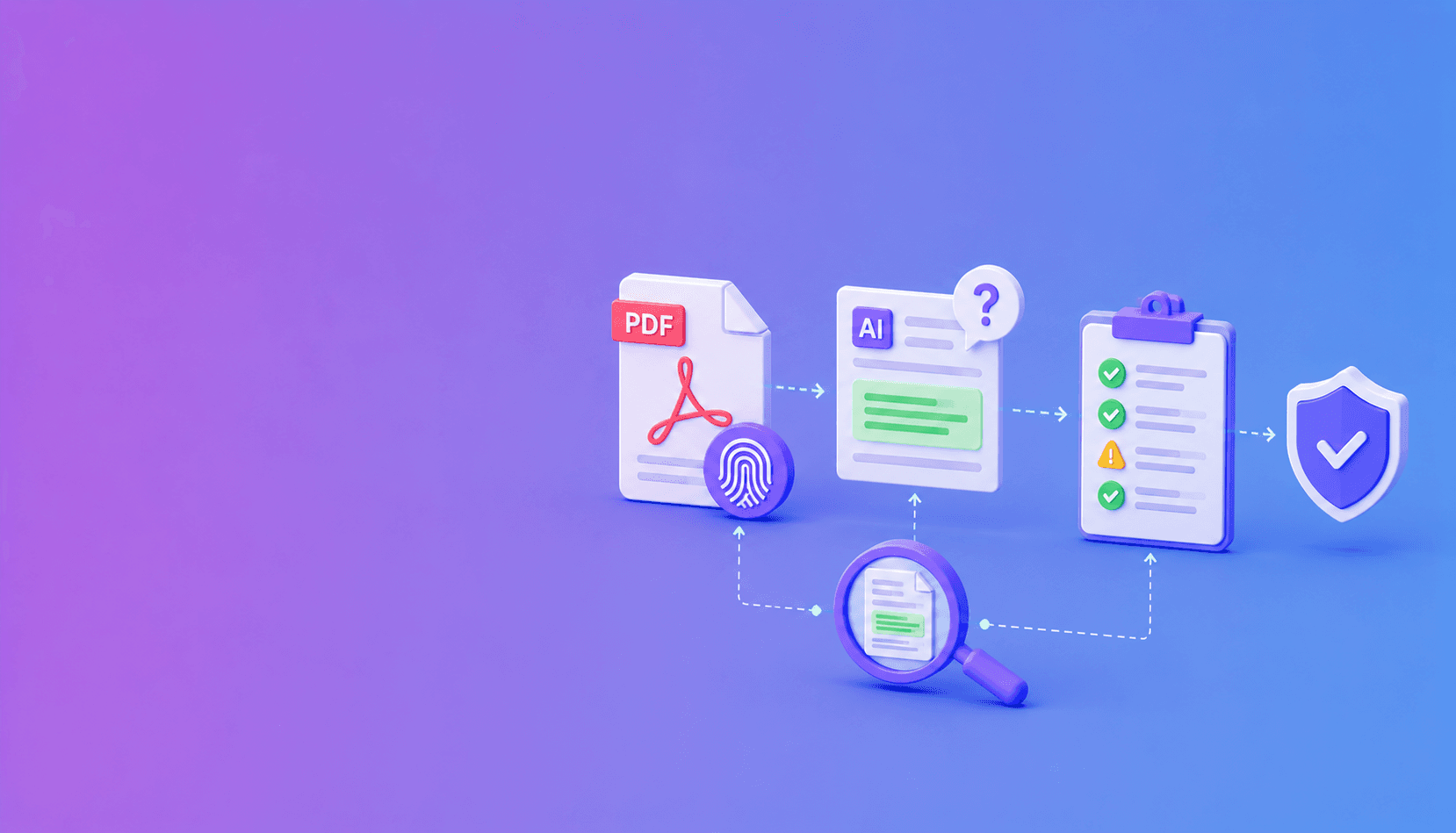
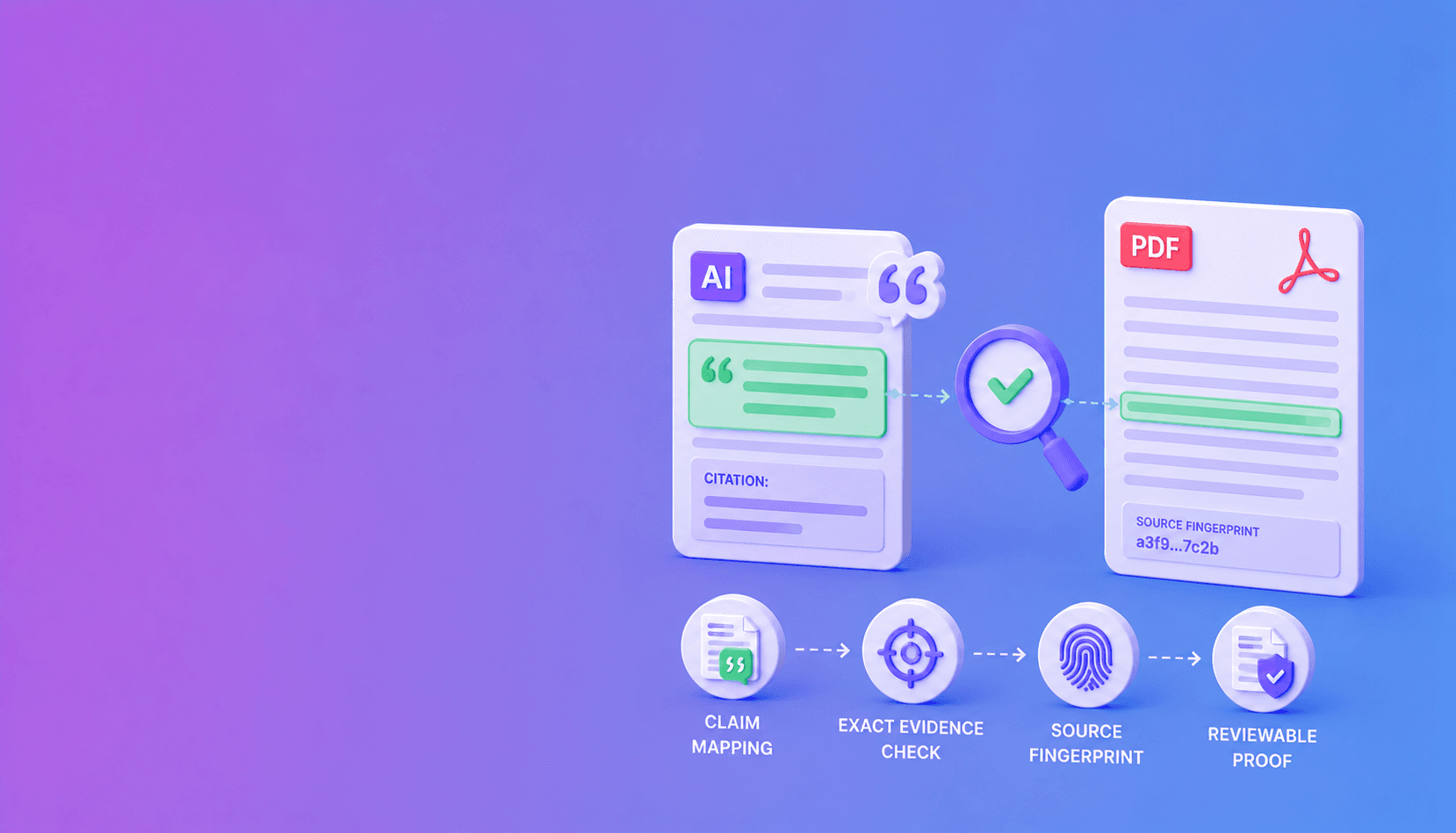
A legal RAG system can prove which page supports an AI answer by binding each material claim to a specific document version, stable machine page index, human-readable page label, source element or bounding region, and exact supporting text. A deterministic verifier then confirms that the source fingerprint and locator resolve and that the expected evidence matches.
The proof must be claim-level. A citation attached to a paragraph containing three legal propositions does not establish which proposition the page supports. Split the answer, verify each evidence reference, preserve the canonical report, and separately review authority, relevance, exceptions, reasoning, and legal effect.
This separation reflects the risk of legal AI use. ABA Formal Opinion 512 addresses lawyers’ responsibilities when using generative AI and says AI outputs—including analysis and citations to authority—must be reviewed for accuracy before submission to a court. Page-level proof makes that review faster and more reproducible; it does not transfer professional judgment to the system.
Why legal RAG needs more than a document link
Legal answers are unusually sensitive to small evidence errors. A passage can be genuine but irrelevant because it comes from:
- a dissent rather than the majority opinion;
- a superseded policy or contract;
- another jurisdiction;
- a headnote rather than the court’s text;
- a quoted argument rather than a holding;
- an exhibit rather than the operative agreement;
- a definition section with an overlooked exception;
- a different pagination edition of the same material.
A URL or file name cannot resolve those distinctions. Even “page 12” is ambiguous when the PDF viewer counts cover pages but the printed document starts numbering later. Scanned exhibits may restart numbering, and slip opinions can be republished with different pagination.
The system therefore needs two page identities:
| Page field | Purpose |
|---|---|
| Machine page index | Stable access within the exact PDF artifact |
| Printed page label | Human reconciliation with visible legal pagination |
Store both. Never convert silently between zero-based and one-based numbering.
The page-proof evidence chain
An audit-ready legal answer should preserve this chain:
matter and user question
        |
        v
atomic legal or factual claim
        |
        v
structured evidence reference
        |
        v
source fingerprint + page + element/region + quote
        |
        v
governed original document
        |
        v
deterministic verification report + legal review decision
Each arrow represents information that must survive the RAG pipeline. If ingestion discards page boundaries, the answer generator cannot recreate trustworthy page citations later. If the application retains only vector-database chunk IDs, reviewers may know what the model retrieved but not where that chunk came from in the controlling artifact.
Step 1: establish the authoritative legal source
Page proof begins before retrieval. Create a source record containing:
- canonical document ID;
- title, court, agency, counterparty, or issuing body;
- document type;
- jurisdiction and matter scope;
- decision, execution, filing, or effective date;
- revision or docket identifier;
- cryptographic content fingerprint;
- authority and validity status;
- access classification and privilege flags;
- parser version and extraction profile.
The fingerprint proves byte identity, not legal authority. A perfectly fingerprinted superseded regulation is still superseded. Authority and status require separate governed metadata, source research, and review.
Never let a model choose the “authoritative” document merely because its text is semantically similar. Resolve authority through a controlled source registry.
Step 2: parse without losing the original page relationship
A legal PDF parser should preserve:
- machine page boundaries and printed labels;
- paragraphs, headings, footnotes, and list items where reliably available;
- text spans and stable element IDs;
- page geometry and coordinate origin;
- tables where the parser can support them;
- OCR and low-confidence warnings;
- links from extracted text back to source regions.
Legal formatting creates edge cases. Footnotes may contain limiting authority. Two-column reporters can scramble reading order. Bates stamps can be confused with printed page numbers. OCR can change not to hot, a section symbol to another character, or a citation year.
Use source-aware PDF parsing and fail visibly when the parser cannot expose evidence strong enough for the requested proof.
Step 3: make the answer claim-addressable
Consider this answer:
The agreement renews annually, either party can terminate on 30 days’ notice, and confidentiality survives termination.
That sentence contains three claims. They may be governed by separate clauses and exceptions. Assign stable IDs:
{
  "answer_id": "answer-0194",
  "claims": [
    {
      "id": "claim-renewal",
      "text": "The agreement renews annually.",
      "claim_type": "source_fact"
    },
    {
      "id": "claim-termination",
      "text": "Either party can terminate on 30 days' notice.",
      "claim_type": "source_fact"
    },
    {
      "id": "claim-confidentiality",
      "text": "Confidentiality survives termination.",
      "claim_type": "source_fact"
    }
  ]
}
Atomic claims prevent one valid citation from laundering unsupported neighboring propositions.
Step 4: create a page-level legal evidence reference
A strong reference identifies the exact source and evidence:
{
  "check_id": "v-claim-termination",
  "claim_id": "claim-termination",
  "source_id": "msa-2026-0047",
  "document_fingerprint": "sha256:expected-document-digest",
  "page_index": 17,
  "page_label": "15",
  "element_id": "p17-e42",
  "quote": "Either party may terminate this Agreement upon thirty (30) days' written notice.",
  "bbox": [72.2, 311.8, 538.4, 354.1],
  "coordinate_origin": "top_left"
}
The quote explains what the page proves. The element and bounding box support exact resolution and inspection. The fingerprint prevents a citation from silently migrating to a revised agreement.
Do not use broad fuzzy matching for legal quotations. Conservative normalization can handle line endings, Unicode, and repeated whitespace, but it must not remove negation, punctuation with legal significance, currency signs, or qualifiers.
Step 5: verify the page reference deterministically
Run checks in a fixed order:
- Resolve
source_idthrough the controlled matter registry. - Confirm the expected fingerprint matches the source artifact.
- Confirm
page_indexis in range. - Reconcile
page_labelwith the stored page map. - Resolve the element or region on that page.
- Compare the expected quote with the resolved text under bounded normalization.
- Confirm the source exposes required geometry or text capabilities.
- Record check-level status, observed evidence, limitations, and verifier version.
| Result | Legal RAG interpretation | Default action |
|---|---|---|
| Grounded | The submitted evidence reference resolves and matches | Continue to authority and semantic review |
| Mismatch | Locator resolves, but expected evidence differs | Block and investigate extraction or generation |
| Not found | Page, element, or region cannot be resolved | Block or regenerate citation |
| Stale fingerprint | Citation targets different document bytes | Re-index against governed version |
| Capability limited | Source cannot prove requested evidence type | Obtain stronger extraction or human review |
| Invalid request | Citation shape is malformed | Reject before release |
The original-PDF verification guide covers these checks across document types.
Step 6: distinguish evidence grounding from legal support
After the page is verified, ask different questions:
- Is this language operative, quoted, historical, or hypothetical?
- Does it apply to the parties, jurisdiction, date, and issue?
- Is the source still valid and authoritative?
- Does another section create an exception?
- Does the claim accurately characterize the rule or holding?
- Is contrary or controlling authority missing?
- Does the proposed conclusion require legal judgment beyond the text?
Ethos does not answer those legal questions. It verifies the bounded citation relationship exposed by the grounding source. A semantic evaluator can help triage support, but qualified legal review owns authority and legal effect.
This prevents a dangerous label: “verified legal answer.” Prefer precise statuses such as “source passage verified; legal conclusion pending review.”
Step 7: show proof a reviewer can inspect
The review interface should display:
- claim text next to its evidence;
- source title, version, and fingerprint reference;
- machine page index and printed page label;
- exact quote with surrounding context;
- page image or bounded crop where permitted;
- OCR, parsing, and capability warnings;
- verification time, verifier version, and report link;
- authority, relevance, and legal-review status as separate fields.
Highlighting the source region is especially valuable for dense agreements and exhibits. The crop must remain bound to the same fingerprint, page, and coordinates as the verification report.
Step 8: protect confidentiality and privilege
Legal RAG evidence can contain privileged, confidential, personal, or sealed information. Page proof must preserve access restrictions rather than turning source excerpts into broadly visible telemetry.
Apply these controls:
- authorize access before retrieval and before evidence display;
- avoid sending protected passages to unapproved external judge models;
- redact public CI logs and metrics;
- encrypt source, citation, crop, and report artifacts;
- separate matter-level storage and retention policies;
- log evidence access without exposing evidence content;
- prevent cached answers from crossing authorization boundaries.
ABA Formal Opinion 512 also addresses confidentiality obligations when lawyers use generative AI. Technical verification does not relax those obligations.
Test the workflow with adversarial legal cases
| Test case | Mutation | Expected behavior |
|---|---|---|
| Correct contract clause | Exact version, page, element, and quote | Grounded; continue to review |
| Wrong page | Correct quote attached to adjacent page | Fail locator or quote binding |
| Superseded policy | Old source fingerprint | Stale; block reuse |
| Dissent confusion | Real passage from dissent labeled as holding | Evidence may ground; authority review blocks |
| Missing exception | Main clause cited, proviso omitted | Citation can ground; semantic/legal review flags incompleteness |
| OCR negation error | not extracted incorrectly | Mismatch or parser warning; require source inspection |
| Bates-label confusion | Stamp used as machine page index | Page-map check fails |
| Unauthorized exhibit | Citation correct but user lacks access | Authorization blocks retrieval and display |
The suite should demonstrate both sides of the boundary: deterministic evidence checks must catch exact citation defects, while legal review must catch genuine but misleading evidence use.
What the audit record should contain
Retain a privacy-safe record with:
- question and answer identifiers;
- atomic claim IDs and text hashes;
- source registry and fingerprint references;
- submitted citations;
- canonical verification report;
- page-proof artifact references;
- retrieval, prompt, model, parser, and verifier versions;
- authority and relevance review decisions;
- final release action and reviewer identity where required.
Do not retain only a green badge. The auditable RAG pipeline guide explains the full provenance chain.
The definitive verdict
Legal RAG proves which page supports an AI answer by preserving an exact, versioned path from each atomic claim to a verified region of the governed document. The minimum proof bundle is source fingerprint, machine page index, printed page label, element or region locator, expected evidence, verification status, and an inspectable report.
That proof answers “where did this evidence come from?” It does not answer “is this the controlling law?” or “is this legal conclusion correct?” Keep authority, semantic support, exceptions, confidentiality, and professional judgment as explicit review layers. The result is not autonomous legal certainty; it is a substantially stronger and more auditable legal research workflow.
Primary keyword: legal RAG page citations Optimized meta title: How Legal RAG Proves Page-Level AI Citations Optimized meta description: Learn how legal RAG proves page-level AI citations using source fingerprints, exact PDF locators, evidence crops, and review controls. Proposed URL slug: how-can-legal-rag-systems-prove-which-page-supports-an-ai-answer
Frequently Asked Questions
Free Tool
PDF to JSON
Turn PDFs into structured, source-aware data for RAG, review, and automation.
Try PDF to JSONDocuShell Team
The DocuShell editorial group writes and maintains guides for everyday PDF workflows, with updates made when tool behavior or documented limits change. See our editorial standards for the process behind each article.
Focus: Legal document RAG, PDF evidence provenance, citation verification, and audit-ready AI workflows
Questions or feedback? Get in touch.